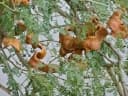
Faidherbia albida
Faidherbia albida
Safety & Hazards
The seeds are toxic[1].
Cultivation Details
White acacia succeeds from the tropical to warm temperate zones, thriving in climates that are characterized by long summers, or a dry season with long days[2]. It grows best in an altitude range of about 270 - 2,700 metres[2]. It grows best in areas where annual daytime temperatures are within the range 18 - 30°c[3]. It is intolerant of frost[4]. It prefers a mean annual rainfall in the range 400 - 1,000mm, but tolerates 250 - 1,200mm[3]. It has succeeded in areas with 1,800mm and, provided there is access to underground water, it can grow independent of rainfall, such as in the Namib Desert[4]. Requires a sunny position, growing best in a coarse-textured, well-drained alluvial soil[2]. It tolerates seasonal waterlogging and saline conditions, but cannot withstand heavy clayey soils[2]. Prefers a pH in the range 5.5 - 7, tolerating 5 - 7.5[3]. The tree has roots that can penetrate 40 metres into the soil to find groundwater and thus help it to withstand drought, even for periods of several years[3, 5]. Observed production of seed by isolated trees is an indication that there is no strict self-incompatibility[2]. The plant has an 'inverted phenology' - it is deciduous during the wet season and produces its leaves in the dry season[2]. Initial top growth can be rather slow as the plant focuses on developing the tap root. One year old plants can be up to 80cm tall and up to 450cm tall by the time they are 5 years old[5]. On very good sites this can be increased, with trees up to 10.5 metres tall at the age of 7 years[5]. Plants commence flowering in about their seventh year and subsequent flowerings occur 1 - 2 months after the start of the dry season, lasting for up to 5 months[2]. The tree responds well to coppicing and regrowth is usually quite vigorous[2, 5]. For bees, the tree has the advantage of producing its flowers at the end of the rains while most of the Sahelian species flower just before or during the rains. It therefore becomes their main source of pollen and nectar at this time[2]. This species has a symbiotic relationship with certain soil bacteria, these bacteria form nodules on the roots and fix atmospheric nitrogen. Some of this nitrogen is utilized by the growing plant but some can also be used by other plants growing nearby[6].
Propagation
Seed - germinates best, especially after storage, if it is pre-soaked in warm water for 24 hours prior to sowing. Germination rates of 40 - 60% can be expected within 6 - 30 days[2]. Mechanical scarification prior to sowing is reported to yield 95% germination within 8 days[2]. The seed is best sown in nursery beds or containers since direct seeding often leads to the high failure rate[2]. Seedlings quickly develop a deep taproot and so need to be planted out as quickly as possible - they are normally ready for planting out when 3 - 4 months old[4, 5]. The seed should be removed from the pods immediately it is ripe, since it is usually invaded by larvae of Bruchid beetles[2]. When kept free of insects in simple closed containers, the seed can be stored successfully for several years[2]. Promising new vegetative propagation methods include cuttings, grafting and multiplication by root fragments[2]. Cite as: Tropical Plants Database, Ken Fern. tropical.theferns.info. 2026-02-20. <tropical.theferns.info/viewtropical.php?id=Faidherbia+albida>
Pollinators
Butterflies, Insects
References
- [1]Potential of Australian Acacias in combating hunger in semi-arid lands — Rinaudo A.; Patel P.; Thomson L.A.J. · 2002 ↩︎
- [2]World Agroforesty Centre — http://www.worldagroforestry.org/ ↩︎An excellent online database of a huge range of trees giving very good information on each plant - its uses, ecology, identity, propagation, pests etc.
- [3]Ecocrop — http://ecocrop.fao.org/ecocrop/srv/en/home ↩︎Basic information on a wide range of useful plants, plus details of environmental needs where available.
- [4]Seed Leaflets — Various · Forest & Landscape. Denmark · http://en.sl.life.ku.dk/Publikationer/Udgivelser/PopulaerPublikationer.aspx?katid={D28373CC-6EF3-4EF8-B097-6D83FABF209E}&serieid={9F1C3DB1-6E7B-4CF1-AF53-F480B0CB40EF}&sort=title ↩︎A series of leaflets, jointly produced by the University of Copenhagen and the Royal Botanic Gardens at Kew, focussing on seed information for a number species, but also giving a lot of other information about each plant.
- [5]Trees and Shrubs of the Sahel. Their Characteristics and Uses. — von Maydell H. · Deutsche Gesellschaft fur Technische Zusammenarbeit; Germany · 1990 · ISBN 3-8236-1198-4 ↩︎A well-researched book, usually with more than one photograph of each species and good information on the plant and its uses.
- [6]Protabase - Plant Resources of Tropical Africa. — http://www.prota.org ↩︎An excellent on-line database with detailed information on over 3,200 species of useful plants of Africa.
- [7]Dictionary of Economic Plants. — Uphof. J. C. Th. · Weinheim · 1959 · ISBN - ↩︎An excellent and very comprehensive guide but it only gives very short descriptions of the uses without any details of how to utilize the plants. Not for the casual reader.