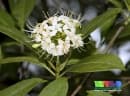
Fagraea fragrans
Fagraea fragrans
Safety & Hazards
Skin rashes may develop when handling green logs with bark on[1].
Cultivation Details
A plant of the wet, lowland tropics, where it is found at elevations up to 400 metres. It grows best in areas where annual daytime temperatures are within the range 20 - 30°c, but can tolerate 10 - 36°c[2]. It prefers a mean annual rainfall in the range 2,000 - 3,000mm, but tolerates 1,000 - 4,000mm[2]. Grows best in a sunny position[2]. Thrives in well-drained to swampy, periodically inundated habitats, occasionally even on permanently inundated localities, often along rivers or creeks[3]. It can succeed on poor or degraded soils so long as they are well-drained, and even in lalang (Imperata cylindrica) grasslands, where it suppresses this noxious grass[3]. Prefers a pH in the range 5 - 6, tolerating 4.5 - 6.5[2]. Established plants are moderately drought tolerant[4]. Considered a useful plantation species, as it is adaptable and hardy[3]. The corky bark gives it some resistance to fire - an 8-year-old plantation in alang alang grassland suffered no damage from a passing fire[3]. The lower branches are very persistent and pruning these promotes height growth[3]. Trees coppice freely; locally, trees may often be pollarded for poles[3]. Large trees are frequently hollow[3].
Propagation
Seed - it has quite a long viability. When sown fresh it has a viability of 65 - 80% and germinates in 15 - 60 days or more[3]. The very fine seed should be mixed with fine sand and sown under light shade[3]. It needs protection from ants[3]. Watering should be done by spraying gently so as not to disturb the seed[3]. The seedlings can be transplanted to open nursery beds or containers after 2 months, when 5 - 7 cm tall, and they can be planted out in the field when 30 - 45 cm high with adhering soil clump[3]. The seed has an initial viability of 80%, which reduces to 65% after being stored for 3 months in air-tight containers[3]. Seeds can be stored for 6 months, but they lose their viability very soon when kept inside the fruit[3]. The fruit should be macerated by hand to extract the seeds, which should then be washed and dried[3]. Allowing the seed to ripen for 1 month after collection is reported, but immediate sowing also gives good results[3]. The whole berry can also be sown, but then seedlings do not appear until after 6 weeks[3]. Root suckers are an easy method of propagation[3]. Cuttings with several internodes taken from the branches of mature trees failed to root, but when taken from coppice shoots they rooted successfully[3]. Cite as: Tropical Plants Database, Ken Fern. tropical.theferns.info. 2026-02-20. <tropical.theferns.info/viewtropical.php?id=Fagraea+fragrans>
Pollinators
Insects
References
- [1]Tropical Timbers of the World. Ag. Handbook No. 607. — Chudnoff. Martin. · USDA Forest Service. Wisconsin. · 1984 ↩︎Terse details on the properties of the wood of almost 400 species of trees from the Tropics.
- [2]Ecocrop — http://ecocrop.fao.org/ecocrop/srv/en/home ↩︎Basic information on a wide range of useful plants, plus details of environmental needs where available.
- [3]World Agroforesty Centre — http://www.worldagroforestry.org/ ↩︎An excellent online database of a huge range of trees giving very good information on each plant - its uses, ecology, identity, propagation, pests etc.
- [4]Tropical and Subtropical Trees - A Worldwide Encyclopaedic Guide. — Barwick. M. · Thames & Hudson, London · 2004 · ISBN 0-500-51181-0 ↩︎A superb book, very concise and well written, giving a wealth of information on 400 or more species including descriptions, habitat, cultivation details and plant uses. A wealth of colour photographs bring each plant vividly to life.
- [5]Seed Leaflets — Various · Forest & Landscape. Denmark · http://en.sl.life.ku.dk/Publikationer/Udgivelser/PopulaerPublikationer.aspx?katid={D28373CC-6EF3-4EF8-B097-6D83FABF209E}&serieid={9F1C3DB1-6E7B-4CF1-AF53-F480B0CB40EF}&sort=title ↩︎A series of leaflets, jointly produced by the University of Copenhagen and the Royal Botanic Gardens at Kew, focussing on seed information for a number species, but also giving a lot of other information about each plant.
- [6]Flora Malesiana Series 1 — Various · Nationaal Herbarium Nederiand, Universiteit Leiden branch · http://www.archive.org ↩︎A massive treatment of the plants of the Malaysian Archipelago. Much of it has been made available to download from the Internet
- [7]Trees of Laos and Vietnam - A Field Guide to 100 species. — Hoang Van Sam; Khamseng Nanthavong; Kessler P.J.A. · Blumea · 2004 ↩︎A detailed guide, with excellent line-drawings, to 100 of the more important trees of Laos and Vietnam. A very good work, giving lots of information about each plant. Originally published in the journal Blumea, it is available as a PDF on the Interne
- [8]Digital Compendium of Forestry Species of Cambodia — www.digitalspecies.blogspot.com; Phnom Penh · 2008 · http://www.digitalspecies.blogspot.com ↩︎A very detailed booklet, produced in PDF format on the internet, giving information on around 100 species of trees.