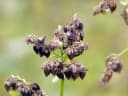
Fagopyrum esculentum
Fagopyrum esculentum
Safety & Hazards
Buckwheat seed is considered to be one of the most important food allergens. It also contains compounds which can cause irritating skin disorders (‘fagopyrism’) mainly in sheep and pigs and occasionally in humans, especially in cases where there is heavy consumption and also exposure to sunlight[1]. Fagopyrism has also been observed in humans after consumption of buckwheat honey. It may also affect cattle when fed pure buckwheat silage[1]. The plant has caused photosensitivity in some people, only the dehusked grain is considered to be safe.
Cultivation Details
Fagopyrum esculentum is a plant of the temperate and subtropical zones, though it can also be grown at higher elevations, generally above 1,500 metres, in the tropics[1]. It grows best in areas where annual daytime temperatures are within the range 17 - 27°c, but can tolerate 7 - 40°c[2]. It is very sensitive to frost[1]. It prefers a mean annual rainfall in the range 700 - 1,000mm, but tolerates 400 - 1,300mm[2]. A very easily grown plant, it prefers dry sandy soils but succeeds in most conditions including poor[3, 4, 5], heavy[6] or acid soils[4] and even sub-soils[7]. It prefers a pH in the range 5 - 6.5, tolerating 4.4 - 7.5[2]. Prefers a cool moist climate, but it also succeeds in dry and arid regions[5]. Hot drying temperatures and drying weather at blooming time blast the flowers and prevent seed formation[2]. The plant has a poorly developed root system that makes it rather sensitive to drought[1]. Buckwheat is a fast-growing plant that can reach its full height within 4 - 6 weeks. Flower formation starts 20 days after emergence, the plant continuing to flower until complete senescence and death of the whole plant. After the onset of flowering, the leaves and stems continue to grow while the fruits develop, hence seed ripening is very uneven, making harvesting difficult. From the middle of the flowering period onwards, when the leaf area has reached its maximum, further growth of the vegetative parts is slow, and producing ripe seed becomes the main focus of the plant. The seed is ready for harvesting 70 - 130 days after emergence, depending on cultivar and ecological conditions[4, 8, 1, 2]. The seed is harvested when most of it (at least 75%) is mature and most leaves have yellowed and dropped. The crop is harvested by mowing, after which the stems are bundled and put in heaps to dry. Farmers prefer to harvest early in the morning or late in the afternoon, or even at night, when the plants are slightly damp from dew, to reduce grain shattering[1]. Average seed yield in the United States is 0.9 - 1 tonne per hectare; in Kenya it is 1 tonne; and in Russia 1 - 1.3 tonnes; but up to 4 tonnes can be obtained[2]. The seed ripens irregularly over a period of several weeks so it is difficult to harvest[4]. Plants have poor frost resistance but they are disease and insect resistant[9]. They inhibit the growth of winter wheat[6, 10, 11]. There are some named varieties[8]. The flowers have a pleasant sweet honey scent[12] and are extremely attractive to bees and hoverflies[13, 5].
Propagation
Seed - sow from the middle of spring to early summer in situ. The seed usually germinates in 5 days[14]. The earlier sowings are for a seed or leaf crop whilst the later sowings are used mainly for leaf crops or green manure. Cite as: Temperate Plants Database, Ken Fern. temperate.theferns.info. 2026-02-21. <temperate.theferns.info/plant/Fagopyrum+esculentum>
Pollinators
Bees, Flies
References
- [1]Protabase - Plant Resources of Tropical Africa. — http://www.prota.org ↩︎An excellent on-line database with detailed information on over 3,200 species of useful plants of Africa.
- [2]Ecocrop — http://ecocrop.fao.org/ecocrop/srv/en/home ↩︎Basic information on a wide range of useful plants, plus details of environmental needs where available.
- [3]Plants for Man. — Schery. R. W. ↩︎Fairly readable but not very comprehensive. Deals with plants from around the world.
- [4]Alternative Enterprises for Agriculture in the UK. — Carruthers. S. P. (Editor) · Centre for Agricultural Strategy, Univ. of Reading · 1986 · ISBN 0704909820 ↩︎Some suggested alternative commercial crops for Britain. Readable. Produced by a University study group.
- [5]Economic Botany. — Hill. A. F. · The Maple Press · 1952 · ISBN - ↩︎Not very comprehensive, but it is quite readable and goes into some detail about the plants it does cover.
- [6]Companion Plants. — Philbrick H. and Gregg R. B. · Watkins · 1979 · ISBN - ↩︎Details of beneficial and antagonistic relationships between neighbouring plants.
- [7]Wonder Crops. 1987. — Natural Food Institute, ↩︎Fascinating reading, this is an annual publication. Some reports do seem somewhat exaggerated though.
- [8]Cornucopia - A Source Book of Edible Plants. — Facciola. S. · Kampong Publications · 1990 · ISBN 0-9628087-0-9 ↩︎Excellent. Contains a very wide range of conventional and unconventional food plants (including tropical) and where they can be obtained (mainly N. American nurseries but also research institutes and a lot of other nurseries from around the world.
- [9]The Milder Garden. — Taylor. J. · Dent · 1990 ↩︎A good book on plants that you didn't know could be grown outdoors in Britain.
- [10]Companion Planting for Successful Gardening. — Riotte. L. · Garden Way, Vermont, USA. · 1978 · ISBN 0-88266-064-0 ↩︎Fairly good.
- [11]A - Z of Companion Planting. — Allardice.P. · Cassell Publishers Ltd. · 1993 · ISBN 0-304-34324-2 ↩︎A well produced and very readable book.
- [12]Scented Flora of the World. — Genders. R. · Robert Hale. London. · 1994 · ISBN 0-7090-5440-8 ↩︎An excellent, comprehensive book on scented plants giving a few other plant uses and brief cultivation details. There are no illustrations.
- [13]A Modern Herbal. — Grieve. · Penguin · 1984 · ISBN 0-14-046-440-9 ↩︎Not so modern (1930's?) but lots of information, mainly temperate plants.
- [14]The Useful Plants of Great Britain. — Johnson. C. P. ↩︎Written about a hundred years ago, but still a very good guide to the useful plants of Britain.
- [15]Flora of the British Isles. — Clapham, Tutin and Warburg. · Cambridge University Press · 1962 · ISBN - ↩︎A very comprehensive flora, the standard reference book but it has no pictures.
- [16]Sturtevant's Edible Plants of the World. — Hedrick. U. P. · Dover Publications · 1972 · ISBN 0-486-20459-6 ↩︎Lots of entries, quite a lot of information in most entries and references.
- [17]Edible and Medicinal Plants. — Launert. E. · Hamlyn · 1981 · ISBN 0-600-37216-2 ↩︎Covers plants in Europe. a drawing of each plant, quite a bit of interesting information.
- [18]Dictionary of Economic Plants. — Uphof. J. C. Th. · Weinheim · 1959 · ISBN - ↩︎An excellent and very comprehensive guide but it only gives very short descriptions of the uses without any details of how to utilize the plants. Not for the casual reader.
- [19]Herbs — Phillips. R. & Foy. N. · Pan Books Ltd. London. · 1990 · ISBN 0-330-30725-8 ↩︎Deals with all types of herbs including medicinal, culinary, scented and dye plants. Excellent photographs with quite good information on each plant.
- [20]Encyclopaedia of Herbs and their Uses. — Bown. D. · Dorling Kindersley, London. · 1995 · ISBN 0-7513-020-31 ↩︎A very well presented and informative book on herbs from around the globe. Plenty in it for both the casual reader and the serious student. Just one main quibble is the silly way of having two separate entries for each plant.
- [21]The Encyclopedia of Medicinal Plants — Chevallier. A. · Dorling Kindersley. London · 1996 · ISBN 9-780751-303148 ↩︎An excellent guide to over 500 of the more well known medicinal herbs from around the world.
- [22]The Dictionary of Modern Herbalism. — Mills. S. Y. ↩︎An excellent small herbal.
- [23]The Dictionary of Useful Plants. — Coon. N. · Rodale Press · 1975 · ISBN 0-87857-090-x ↩︎Interesting reading but short on detail.
- [PFAF]Plants for a Future — pfaf.org ↩︎