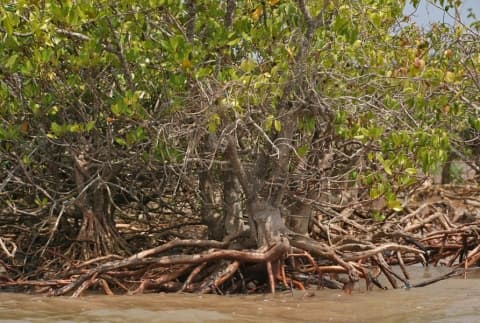
Excoecaria agallocha
Excoecaria agallocha
Safety & Hazards
All parts of the plant are poisonous[1]. The tree exudes a very acrid poisonous juice, particularly from the fresh cortex when cut, which raises blisters on the skin and is injurious to the eyes of wood-cutters, whence the name 'blinding tree'[2]. The latex is used as a fish poison[2]. The crushed leaves, when placed in the water, stupefy the fish and cause them to float to the surface[3].
Cultivation Details
A plant of the lowland tropics and subtropics, where it is found at elevations up to 400 metres. It grows best in areas where annual daytime temperatures are within the range 20 - 30°c, but can tolerate 15 - 37°c[2]. It prefers a mean annual rainfall in the range 1,000 - 2,000mm, but tolerates 800 - 4,100mm[2]. Requires a sunny position[2]. Succeeds in a wide range of fertile soils[2]. Tolerant of saline soils[2]. Prefers a pH in the range 6.5 - 7, tolerating 6 - 8[2]. A dioecious species, both male and female forms need to be grown if fruit and seed are required[3].
Propagation
Seed - Cite as: Tropical Plants Database, Ken Fern. tropical.theferns.info. 2026-02-20. <tropical.theferns.info/viewtropical.php?id=Excoecaria+agallocha>
Pollinators
Data unavailable
References
- [1]Plant Resources of Southeast Asia — http://proseanet.org/ ↩︎Lots of information on the uses of the plants of SE Asia.
- [2]Ecocrop — http://ecocrop.fao.org/ecocrop/srv/en/home ↩︎Basic information on a wide range of useful plants, plus details of environmental needs where available.
- [3]Medicinal Plants in Papua New Guinea — World Health Organisation · 2009 · ISBN 978-92-9061-249-0 ↩︎Traditional medicinal uses of 126 species from Papua New Guinea, including information on modern research into the plants.
- [4]Flora of China — Missouri Botanical Garden Press; St. Louis. · 1994 · http://flora.huh.harvard.edu/china/ ↩︎An excellent, comprehensive resource in 25 volumes. In addition to the botanical information the flora also gives basic information on habitat and some uses. An on-line version is also available.
- [5]IUCN Red List of Threatened Species — http://www.iucnredlist.org/ ↩︎A list of plants under threat and facing possible extinction, usually with brief details of the threats and information on habitat.
- [6]Dictionary of Economic Plants. — Uphof. J. C. Th. · Weinheim · 1959 · ISBN - ↩︎An excellent and very comprehensive guide but it only gives very short descriptions of the uses without any details of how to utilize the plants. Not for the casual reader.
- [7]The Useful Plants of the Island of Guam — Safford W.E. · Smithsonian Institute; Washington. · 1905 · http://www.biodiversitylibrary.org/ ↩︎A very comprehensive, if rather dated, guide to the plants of Guam. It can be downloaded from the Internet.
- [PFAF]Plants for a Future — pfaf.org ↩︎