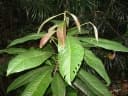
Cultivation Details
A plant of the lowland, moist tropics, where it is found at elevations up to 625 metres. It grows best in areas where annual daytime temperatures are within the range 20 - 30°c, but can tolerate 10 - 38°c[2]. It prefers a mean annual rainfall in the range 2,500 - 4,000mm, but tolerates 2,000 - 4,500mm[2]. Seedlings require some shade, while older trees need plenty of light[2]. Prefers well-drained soils in valleys or on hillsides or even low ridges when soil moisture is sufficient[1]. Prefers a pH in the range 5 - 6, tolerating 4.5 - 6.5[2]. Trees may begin to flower at an age of 15 - 20 years[1]. They bear fruits at irregular intervals, often every 2 - 3 years, sometimes annually. Fruits ripen within 3 months after flowering. Seed dispersal is apparently often by water; rich pockets of ulin forest are often found at places where the fruits wash ashore in large quantities along rivers[1]. Plants can coppice freely[1].
Propagation
Seeds are often placed horizontally between two beds of grass, or they are covered with 2 - 5 cm of soil[1]. Germination usually starts after about 2 weeks (but it may take 6 - 12 months) and the germination rate is approximately 40%[1]. Scarification (cutting off the top of the seed or removing the whole outer shell) may improve the germination rate to 70%[1]. Nursery-raised seedlings or wildlings of about 40 cm tall, a height reached after 1 - 1.5 years, are planted into the field at a spacing of 3 metres x 4 metres and need shade[1]. Cite as: Tropical Plants Database, Ken Fern. tropical.theferns.info. 2026-02-20. <tropical.theferns.info/viewtropical.php?id=Eusideroxylon+zwageri>
Pollinators
Data unavailable
References
- [1]World Agroforesty Centre — http://www.worldagroforestry.org/ ↩︎An excellent online database of a huge range of trees giving very good information on each plant - its uses, ecology, identity, propagation, pests etc.
- [2]Ecocrop — http://ecocrop.fao.org/ecocrop/srv/en/home ↩︎Basic information on a wide range of useful plants, plus details of environmental needs where available.
- [3]Plant Resources of Southeast Asia — http://proseanet.org/ ↩︎Lots of information on the uses of the plants of SE Asia.
- [4]IUCN Red List of Threatened Species — http://www.iucnredlist.org/ ↩︎A list of plants under threat and facing possible extinction, usually with brief details of the threats and information on habitat.
- [5]Global Tree Campaign - 40 Species in Trade — http://www.unep-wcmc.org/trees/trade/40_species_in_trade.htm ↩︎Information on the habitats, uses and some cultivation notes for 40 species of timber trees.