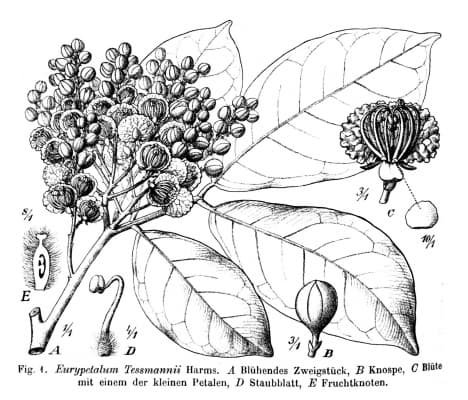
Fabaceae FAMILY Least Concern
Eurypetalum tessmannii
Eurypetalum tessmannii
Edibility
0/5
Medicinal
0/5
Safety & Hazards
None known
Cultivation Details
HabitEvergreen Tree
Growth—
Found in the wild mainly on clay and loamy soils[1]. In the forest, trees are often surrounded by sprouts from the base of the bole; these sprouts may form circles of up to 5 metres in diameter[2]. The flowers are possibly functionally unisexual. Trees with only apparently male flowers are more common than trees with apparently female flowers, in a proportion of approximately 4:1[2]. The fruits are explosively dehiscent with spiralling valves, dispersing the seeds over some distance[2].
Propagation
Seed - Cite as: Tropical Plants Database, Ken Fern. tropical.theferns.info. 2026-02-20. <tropical.theferns.info/viewtropical.php?id=Eurypetalum+tessmannii>
Pollinators
Data unavailable
References
- [1]African Flowering Plants Database — Conservatoire et Jardin Botaniques. · http://www.ville-ge.ch/musinfo/bd/cjb/africa/recherche.php ↩︎Contains information on over 150,000 plant names (including synonyms) giving a description and habitat, plus a distribution map.
- [2]Protabase - Plant Resources of Tropical Africa. — http://www.prota.org ↩︎An excellent on-line database with detailed information on over 3,200 species of useful plants of Africa.
- [3]Révision du genre Eurypetalum Harms (Fabaceae, Caesalpinioideae) — Diosdado Obiang-Mbomio, Franciscus J. Breteler · 2007 ↩︎
- [4]IUCN Red List of Threatened Species — http://www.iucnredlist.org/ ↩︎A list of plants under threat and facing possible extinction, usually with brief details of the threats and information on habitat.
- [5]The Useful Plants of West Tropical Africa. — Burkil. H. M. · Royal Botanic Gardens; Kew. · 1985 - 2004 ↩︎Brief descriptions and details of the uses of over 4,000 plants. A superb, if terse, resource, it is also available electronically on the Web - see http://www.aluka.org/