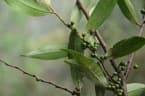
Eurya acuminata
Eurya acuminata
Safety & Hazards
None known
Cultivation Details
Eurya acuminata is a plant of the subtropical to tropical zones, where it is found at elevations up to 3,000 metres. It can also be grown in warmer parts of the temperate zone in areas where frosts are light and not very common[1]. Prefers a moderately fertile free-draining moisture retentive soil in sun or part shade with shelter from cold drying winds[1]. A fast-growing plant[2]. The plant has an unpleasant, pungent aroma[3]. A dioecious species, in general both male and female forms must be grown if seed is required[4]. However, there are cases of cleistogomy where seeds are produced without fertilization[5].
Propagation
Seed - sow as soon as it is ripe in a cold frame or sow in early spring in a greenhouse[1]. When they are large enough to handle, prick the seedlings out into individual pots and grow them on in the greenhouse for at least their first winter. Plant them out into their permanent positions in late spring or early summer, after the last expected frosts. Cuttings of half-ripe wood, 6 - 8cm with a slight heel, mid summer in individual pots in a frame. High percentage[6]. Cite as: Temperate Plants Database, Ken Fern. temperate.theferns.info. 2026-02-21. <temperate.theferns.info/plant/Eurya+acuminata>
Pollinators
Insects, Cleistogomy
References
- [1]The New RHS Dictionary of Gardening. 1992. — Huxley. A. · MacMillan Press · 1992 · ISBN 0-333-47494-5 ↩︎Excellent and very comprehensive, though it contains a number of silly mistakes. Readable yet also very detailed.
- [2]Forest Restoration Planting in Northern Thailand — Pakkad G.; Elliott S.; Anusarnsunthorn V. Et al · Food and Agriculture Organization of the United Nations; Bangkok · 2002 · http://www.fao.org/ ↩︎A report on reforestation in northern Thailand by using specific pioneer species. It can be downloaded from the Internet.
- [3]Plant Resources of Southeast Asia — http://proseanet.org/ ↩︎Lots of information on the uses of the plants of SE Asia.
- [4]Flora of China — Missouri Botanical Garden Press; St. Louis. · 1994 · http://flora.huh.harvard.edu/china/ ↩︎An excellent, comprehensive resource in 25 volumes. In addition to the botanical information the flora also gives basic information on habitat and some uses. An on-line version is also available.
- [5]IUCN Red List of Threatened Species — http://www.iucnredlist.org/ ↩︎A list of plants under threat and facing possible extinction, usually with brief details of the threats and information on habitat.
- [6]Propagation of Trees, Shrubs and Conifers. — Sheat. W. G. · MacMillan and Co · 1948 · ISBN - ↩︎A bit dated but a good book on propagation techniques with specific details for a wide range of plants.
- [7]Biotik, Laos — http://biotik.org/species_list_laos.html ↩︎Information on more than 100 species of Laotian trees.
- [8]A Manual of Indian Timbers. — Gamble. J. S. · Bishen Singh Mahendra Pal Singh · 1972 · ISBN - ↩︎First written in the 19th century, but still a classic, giving a lot of information on the uses and habitats of Indian trees. Not for the casual reader.
- [9]Plants and People of Nepal — Manandhar. N. P. · Timber Press. Oregon. · 2002 · ISBN 0-88192-527-6 ↩︎Excellent book, covering over 1,500 species of useful plants from Nepal together with information on the geography and peoples of Nepal. Good descriptions of the plants with terse notes on their uses.
- [10]Wild edible plants from the Dima Hasao district of Assam, India — Mehdi P. et al · 2014 · ISBN 0973-9467 ↩︎
- [11]Ethnomedicinal Plants of North-East India — Choudhury S.; Bahadue B. & Pullaiah T. · Apple Academic Press; Oakville, Canada · ISBN 13: 978-1-77188-4 ↩︎
- [12]Five hundred plant species in Gunung Halimun Salak National Park, West Java — Hari Priyadi et al · Center for International Forestry Research; Indonesia. · 2010 · http://www.cifor.cgiar.org · ISBN 978-602-8693-22-6 ↩︎Brief details of the uses of 500 Indonesian plants. It is available as a PDF document to download from the internet.
- [13]The Gardens' Bulletin Straits Settlements Vol VI — Singapore Botanic Gardens; Singapore. · 1930 ↩︎A botanical publication of Singapore Botanic Gardens, with a range of articles. This one focuses on the medicinal plants of the region.
- [14]Ethnomedicinal Plants Used Against Skin Diseases in Some Villages of Kali Gandaki, Bagmati and Tadi Likhu Watersheds — Joshi A.R. & Joshi K. · 2007 ↩︎
- [15]Medicinal Plants Used by Chakma Tribe in Hill Tracts Districts of Bangladesh. — Rahman M.A.; Uddin S.B.; Wilcock C.C. · Indian Journal of Traditional Knowledge. · 2007 Vol 6(3) ↩︎Brief details of medicinal plants used by the Chakma tribe.
- [16]Forest Flora of Chakrata, Dehra Dun and Saharanpur. — Gupta. B. L. · Forest Research Institute Press · 1945 · ISBN - ↩︎A good flora for the middle Himalayan forests, sparsly illustrated. Not really for the casual reader.