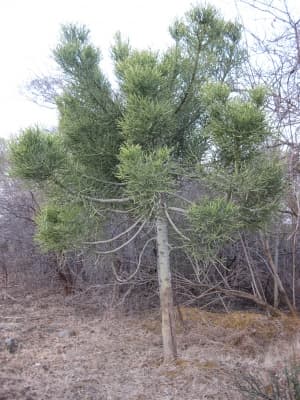
Euphorbia tirucalli
Euphorbia tirucalli
Safety & Hazards
The caustic, irritant sap contains a latex and is highly poisonous, causing severe injury to the eye, irritation and vesication from contact, emesis and purgation from ingestion[1, 2]. Eye contact with the sap can cause blindness lasting several days[3]. The toxicity of the latex is considered seasonal or reduced in young plant parts, and young branches are even roasted and chewed[1]. The extracts of the plant contain a number of esters of the tetracyclic diterpenoid phorbol, many of which have been shown to act as tumour promoters (cocarcinogens). Their co-carcinogenic effect on lymphoblastoid cells poses a real threat in Africa where drinking water is drawn around the plants[2]. In East Africa the latex is commonly used as arrow poison and as an ingredient for bait to kill rodents and other wild animals; the pulped stems are thrown in water as fish poison[1]. In south-western DR Congo the latex has been used in high doses as a trial by ordeal poison; in various countries it is used as criminal poison[1].
Cultivation Details
Succeeds in subtropical to tropical regions at elevations from sea level to 2,000 metres[2]. The plant is very well adapted to semi-arid conditions, but also occurs in both dry and moist forest, savannah and shrub land, and also withstands salt stress associated with coastal conditions[1]. It grows best in areas where annual daytime temperatures are within the range 25 - 37°c, but can tolerate 12 - 41°c[4]. Plants are not tolerant of frost[5]. It prefers a mean annual rainfall in the range 400 - 800mm, but tolerates 250 - 1,000mm[4]. The plant can grow in areas where the mean annual rainfall can range from 250 - 4,000mm[2]. Requires a sunny position[5]. Appears to grow on almost any soil type[2, 3]. Prefers a wide variety of well-drained, light-textured, neutral to acidic soils[5]. Prefers a pH in the range 5.5 - 6.5, tolerating 4.5 - 7.5[4]. Established plants are very drought tolerant[5]. Plants are very tolerant of trimming and also coppice well when cut at 20 - 30cm height. Under semi arid conditions regrowth is excellent[1, 2]. A density of 10,000 - 20,000 plants per hectare is normal when grown as a fuel crop. When planted at a spacing of 1metre x 1metre it produced 120 tonnes/ha fresh material and 14 tonnes/ha dry matter after 1 year, yielding 40 - 88 kg of crude oil, 135 - 213 kg of sugar and 1.8 tonnes of bagasse[2]. There have been plantings of E. Tirucalli in Okinawa which on a spacing of 120cm between bushes are expected to yield 11 - 22 barrels of oil per hectare each year[3]. Plants are not resistant to fire[5]. Plants usually produce male flowers. Female flowers or plants are much less common. Plants with bisexual flowers also occur, although the female flower apparently often aborts[2].
Propagation
Seed - Cuttings root easily. Cut fresh branches from a healthy bush. Cuttings should be at least 10cm long, and should be left to dry for at least 24 hours before planting. For ornamental purposes, cuttings of 35 - 40cm long are usually taken and for hedges cuttings of up to 1 metre long can be used[1]. Take care to avoid direct contact with the milky sap, which can cause skin irritation. Plant at the onset of the rainy season in shallow trenches about 20 cm deep where water can collect[5]. Cite as: Tropical Plants Database, Ken Fern. tropical.theferns.info. 2026-02-20. <tropical.theferns.info/viewtropical.php?id=Euphorbia+tirucalli>
Pollinators
Data unavailable
References
- [1]Protabase - Plant Resources of Tropical Africa. — http://www.prota.org ↩︎An excellent on-line database with detailed information on over 3,200 species of useful plants of Africa.
- [2]World Agroforesty Centre — http://www.worldagroforestry.org/ ↩︎An excellent online database of a huge range of trees giving very good information on each plant - its uses, ecology, identity, propagation, pests etc.
- [3]The Useful Plants of West Tropical Africa. — Burkil. H. M. · Royal Botanic Gardens; Kew. · 1985 - 2004 ↩︎Brief descriptions and details of the uses of over 4,000 plants. A superb, if terse, resource, it is also available electronically on the Web - see http://www.aluka.org/
- [4]Ecocrop — http://ecocrop.fao.org/ecocrop/srv/en/home ↩︎Basic information on a wide range of useful plants, plus details of environmental needs where available.
- [5]Indigenous multipurpose trees of Tanzania. — Hines. D.A. & Eckman. K. · 1993 · ISBN 0-9697075-0-9 ↩︎A simple handbook with information on over 50 species of trees found in Tanzania giving details of environmental requirements, cultivation needs, uses etc. It can be downloaded from the Internet.
- [6]Tropical Ornamentals; A Guide — Whistler. W. Arthur. · Timber Press Inc. Oregon. · 2000 · ISBN 0-88192-448-2 ↩︎An excellent little guide to some of the more commonly cultivated ornamental plants of the Tropics, often giving some information on the plants other uses.
- [7]Philippine Medicinal Plants — http://www.stuartxchange.org/CompleteList.html ↩︎A lovely site, giving brief details on the medicinal uses of several hundred (over 400 at the last count) plants in the Philippines, plus a picture of each plant.
- [8]IUCN Red List of Threatened Species — http://www.iucnredlist.org/ ↩︎A list of plants under threat and facing possible extinction, usually with brief details of the threats and information on habitat.