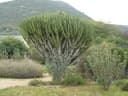
Euphorbia ingens
Euphorbia ingens
Safety & Hazards
The latex is very toxic, causing intense irritation and blistering to the skin and mucous membranes. If the latex comes into contact with the eyes, it causes temporary or even permanent blindness[1]. A bundle of grass is soaked in the latex and then thrown into water as a fish poison[1]. Different concentrations of latex were used in mortality tests with several aquatic animals. The latex was found to be a short-lived and effective fish poison. Within 12 hours all the fish and half the frogs died, whereas crabs and snails appeared not to suffer any detrimental effects. The poison degraded and became harmless to fish within 48 hours[1]. The flowers of this species, and several other tree-sized Euphorbia species, produce an abundance of nectar, but the honey, known as ‘noors honey’, causes a burning sensation in the mouth, which is intensified by drinking water[1].
Cultivation Details
The plant can survive in areas that go through long periods of drought or are generally very dry[1]. Plants can survive moderate frosts down to around -2°c[2]. Prefers an open, sunny position[1, 3]. Succeeds in dry, gritty, well-drained soils[3]. This tree prefers warm areas and can survive in areas that go through long periods of drought or are generally very dry. It usually grows on rocky outcrops or in deep sand within bushveld vegetation[4]. Birds like nesting in these trees; hole-nesting birds such as woodpeckers often use dead sections[1].
Propagation
Seed - Cuttings root easily. They need to be stored in light shade for a few days to dry before being planted, or else they will rot. It is best to plant the cuttings when the rain is about to stop, in a well-drained soil[1]. Cite as: Tropical Plants Database, Ken Fern. tropical.theferns.info. 2026-02-20. <tropical.theferns.info/viewtropical.php?id=Euphorbia+ingens>
Pollinators
Butterflies, Bees, Insects
References
- [1]Protabase - Plant Resources of Tropical Africa. — http://www.prota.org ↩︎An excellent on-line database with detailed information on over 3,200 species of useful plants of Africa.
- [2]Desert Tropicals — http://www.desert-tropicals.com/ ↩︎The main focus of the site is succulent plants, but it also contains information on a wide range of other species. Usually at least one good photograph, plus basic information about the plant and its cultivation.
- [3]Tropical Flowering Plants. A Guide to Identification and Cultivation. — Llamas K.A. · Timber Press; Oregon. · 2003 · ISBN 0-88192-585-3 ↩︎A terse guide for the gardener to almost 1,500 species of ornamental tropical plants with brief details on their cultivation and, usually, a small photograph of good quality.
- [4]PlantZAfrica.com — http://www.plantzafrica.com ↩︎An excellent site giving detailed descriptions and uses of many S. African plants.
- [5]African Flowering Plants Database — Conservatoire et Jardin Botaniques. · http://www.ville-ge.ch/musinfo/bd/cjb/africa/recherche.php ↩︎Contains information on over 150,000 plant names (including synonyms) giving a description and habitat, plus a distribution map.