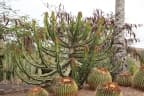
Euphorbia cooperi
Euphorbia cooperi
Safety & Hazards
The latex is said to be one of the most poisonous of the Euphorbia spp., causing intense skin irritations and producing a burning sensation in the throat when standing next to bleeding plants. The latex may cause blindness if it comes into the eyes. It has a pungent, acrid smell[1]. The flowers produce much nectar, but the honey, known as ‘noors honey’, causes a burning sensation in the mouth, which is intensified by drinking water[1]. The latex is used as a fish poison[1].
Cultivation Details
A plant of drier areas in the tropics and subtropics, where it can be found at elevations up to 1,500 metres. The plant is intolerant of frost[2]. An easy plant to cultivate[3]. It does not require much water at all and naturally occurs in the mixed bushveld biome[4]. It prefers sandy, loamy to clay soils and will grow in grassland as well as on granite koppies or ridges that occur in these regions. A sunny spot on the warm sunny side of the garden would be ideal for these water-wise plants[4] The ripe fruits burst open, flinging seeds several metres away[1].
Propagation
Seed - easy[1]. Cuttings root easily. The cuttings must be dried for a day or two before planting in order to prevent them rotting. Great care must be taken when collecting cuttings, to prevent the poisonous latex from coming into contact with skin or eyes[1]. Cite as: Tropical Plants Database, Ken Fern. tropical.theferns.info. 2026-02-20. <tropical.theferns.info/viewtropical.php?id=Euphorbia+cooperi>
Pollinators
Bees
References
- [1]Protabase - Plant Resources of Tropical Africa. — http://www.prota.org ↩︎An excellent on-line database with detailed information on over 3,200 species of useful plants of Africa.
- [2]Desert Tropicals — http://www.desert-tropicals.com/ ↩︎The main focus of the site is succulent plants, but it also contains information on a wide range of other species. Usually at least one good photograph, plus basic information about the plant and its cultivation.
- [3]African Flowering Plants Database — Conservatoire et Jardin Botaniques. · http://www.ville-ge.ch/musinfo/bd/cjb/africa/recherche.php ↩︎Contains information on over 150,000 plant names (including synonyms) giving a description and habitat, plus a distribution map.
- [4]PlantZAfrica.com — http://www.plantzafrica.com ↩︎An excellent site giving detailed descriptions and uses of many S. African plants.