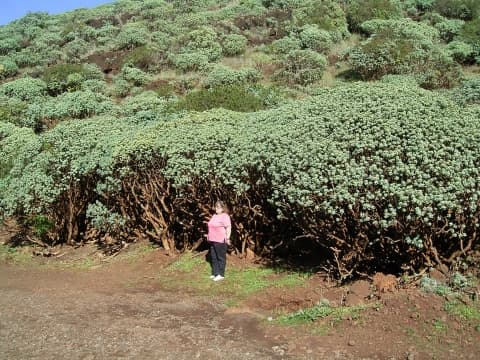
Euphorbia balsamifera
Euphorbia balsamifera
Safety & Hazards
The plant, and more specifically the latex, are generally reported to be toxic[1]. The latex is known to be dangerous to the eyes and the plant has been used for criminal purposes, in ordeal-poisons and in arrow-poisons[1]. However, there are reports of consumption by people, and of people feeding their livestock with this plant. In a superstitious sense it is fed to camels in the Sahara as the lichen commonly covering the bark is said to enable them to see by night. The Fula of N Nigeria sometimes feed the latex to their cattle and other stock to promote fertility and to increase their milk flow. Superstition or no, this can hardly be practiced without a sense of responsible husbandry. It must appear that the toxicity of the plant needs examination in its edaphic and phenological context[1].
Cultivation Details
Requires a sunny position. Requires a deep, well-drained, sandy or gritty soil[1, 2]. Established plants are very drought tolerant[3].
Propagation
Seed - Cuttings root easily and grow away quickly. They are best if taken at least 50cm long, can be planted directly where the plant is to grow, and can even survive many months of drought and still grow away afterwards[3]. Cite as: Tropical Plants Database, Ken Fern. tropical.theferns.info. 2026-02-20. <tropical.theferns.info/viewtropical.php?id=Euphorbia+balsamifera>
Pollinators
Data unavailable
References
- [1]The Useful Plants of West Tropical Africa. — Burkil. H. M. · Royal Botanic Gardens; Kew. · 1985 - 2004 ↩︎Brief descriptions and details of the uses of over 4,000 plants. A superb, if terse, resource, it is also available electronically on the Web - see http://www.aluka.org/
- [2]Bihrmann's Caudiciforms — http://www.bihrmann.com/caudiciforms/ ↩︎An internet site giving information on caudiciform plants (plants with swollen stem bases such as the Baobab tree, cycads and many succulents). Excellent photos, usually of cultivated plants in pots.
- [3]Trees and Shrubs of the Sahel. Their Characteristics and Uses. — von Maydell H. · Deutsche Gesellschaft fur Technische Zusammenarbeit; Germany · 1990 · ISBN 3-8236-1198-4 ↩︎A well-researched book, usually with more than one photograph of each species and good information on the plant and its uses.
- [4]African Flowering Plants Database — Conservatoire et Jardin Botaniques. · http://www.ville-ge.ch/musinfo/bd/cjb/africa/recherche.php ↩︎Contains information on over 150,000 plant names (including synonyms) giving a description and habitat, plus a distribution map.
- [5]Sturtevant's Edible Plants of the World. — Hedrick. U. P. · Dover Publications · 1972 · ISBN 0-486-20459-6 ↩︎Lots of entries, quite a lot of information in most entries and references.