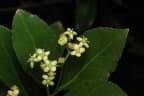
Euonymus japonicus
Euonymus japonicus
Cultivation Details
A plant of the warm temperate zone, though often cultivated in the tropics as an ornamental, where it is found at elevations up to 1,500 metres. It grows best in areas where annual daytime temperatures are within the range 12 - 20°c, but can tolerate 4 - 28°c[3]. When dormant, the plant can survive temperatures down to about -10°c[4]. The plant prefers night temperatures of 4 - 12°c and day temperatures of 19°c or lower[3]. It prefers a mean annual rainfall in the range 700 - 1,300mm, but tolerates 500 - 1,500mm[3]. Grows best in a suny position, tolerating some shade but not fruiting well in such a position[5]. It is particularly suited to dry shaded areas[6]. Thrives in almost any soil, including chalk and sandy soils[6]. Grows well in heavy clay soils. Prefers a well-drained loamy soil[5]. The plant is best grown in a dry soil and an open position when being grown for its latex[7, 2]. Prefers a pH in the range 5 - 6, tolerating 4.5 - 6.5[3]. Plants are very tolerant of maritime exposure, succeeding even when grown on the sea shore[8], but they can be killed by cold drying winds[9, 4]. Plants are more likely to succumb to the cold if they are regularly trimmed (this exposes young growth to the cold), this regular trimming also leads to mildew especially when plants are growing in very dry ground[10]. Plants are often slow to get established. Plants can be susceptible to attacks by caterpillars[10] and are often damaged during the flowering season[5]. They are also a host of the sugar beet fly[11]. This species is notably resistant to honey fungus[6].
Propagation
Seed - best sown as soon as it is ripe in a cold frame[12]. Stored seed requires 3 months cold stratification, so should be sown as early in the year as possible in a cold frame[13]. Seed can take 18 months to germinate[2]. When they are large enough to handle, prick the seedlings out into individual pots and grow them on in the greenhouse for at least their first winter. Plant them out into their permanent positions in late spring or early summer, after the last expected frosts. Cuttings of half-ripe wood, 5 - 7cm long taken at a node or with a heel, mid summer in a frame. Very easy[6]. Cuttings of mature wood, early autumn in a frame78, 113 Title The Reference Manual of Woody Plant Propagation. Publication Author Dirr. M. A. and Heuser. M. W. Publisher Athens Ga. Varsity Press Year 1987 ISBN 0942375009 Description A very detailed book on propagating trees. Not for the casual reader. ]. Cuttings will root readily at any time of the year if given bottom heat[14]. Root cuttings in winter. Cite as: Temperate Plants Database, Ken Fern. temperate.theferns.info. 2026-02-21. <temperate.theferns.info/plant/Euonymus+japonicus>
Pollinators
Insects
References
- [1]A Colour Atlas of Poisonous Plants. — Frohne. D. and Pfänder. J. · Wolfe · 1984 · ISBN 0723408394 ↩︎Brilliant. Goes into technical details but in a very readable way. The best work on the subject that I've come across so far.
- [2]Flora of the USSR. — Komarov. V. L. · Israel Program for Scientific Translation · 1968 · http://www.biodiversitylibrary.org · ISBN - ↩︎An immense (25 or more large volumes) and not yet completed translation of the Russian flora. Full of information on plant uses and habitats but heavy going for casual readers. It can be downloaded from the Internet.
- [3]Ecocrop — http://ecocrop.fao.org/ecocrop/srv/en/home ↩︎Basic information on a wide range of useful plants, plus details of environmental needs where available.
- [4]Shrubs. — Phillips. R. & Rix. M. · Pan Books · 1989 · ISBN 0-330-30258-2 ↩︎Excellent photographs and a terse description of 1,900 species and cultivars.
- [5]Trees and Shrubs Hardy in Great Britain. Vol 1 - 4 and Supplement. — Bean. W. · Murray · 1981 · ISBN - ↩︎A classic with a wealth of information on the plants, but poor on pictures.
- [6]The New RHS Dictionary of Gardening. 1992. — Huxley. A. · MacMillan Press · 1992 · ISBN 0-333-47494-5 ↩︎Excellent and very comprehensive, though it contains a number of silly mistakes. Readable yet also very detailed.
- [7]A Dictionary of Plants Used by Man. — Usher. G. · Constable · 1974 · ISBN 0094579202 ↩︎Forget the sexist title, this is one of the best books on the subject. Lists a very extensive range of useful plants from around the world with very brief details of the uses. Not for the casual reader.
- [8]The Milder Garden. — Taylor. J. · Dent · 1990 ↩︎A good book on plants that you didn't know could be grown outdoors in Britain.
- [9]Shelter Trees and Hedges. — Rosewarne experimental horticultural station. · Ministry of Agriculture, Fisheries and Food · 1984 · ISBN - ↩︎A small booklet packed with information on trees and shrubs for hedging and shelterbelts in exposed maritime areas.
- [10]Ornamental Shrubs, Climbers and Bamboos. — Thomas. G. S. · Murray · 1992 · ISBN 0-7195-5043-2 ↩︎Contains a wide range of plants with a brief description, mainly of their ornamental value but also usually of cultivation details and varieties.
- [11]Shrubs for the Milder Counties. — Arnold-Forster. ↩︎Trees and shrubs that grow well in Cornwall and other mild areas of Britain. Fairly good, a standard reference book.
- [12]The Plantsman. Vol. 3. 1981 - 1982. — ? · Royal Horticultural Society · 1981 · ISBN - ↩︎Excerpts from the periodical giving cultivation details and other notes on some of the useful plants..
- [13]The Reference Manual of Woody Plant Propagation. — Dirr. M. A. and Heuser. M. W. · Athens Ga. Varsity Press · 1987 · ISBN 0942375009 ↩︎A very detailed book on propagating trees. Not for the casual reader.
- [14]RHS Dictionary of Plants plus Supplement. 1956 — F. Chittendon. · Oxford University Press · 1951 · ISBN - ↩︎Comprehensive listing of species and how to grow them. Somewhat outdated, it has been replaced in 1992 by a new dictionary (see [ 200 ]).
- [15]Flora Malesiana Series 1 — Various · Nationaal Herbarium Nederiand, Universiteit Leiden branch · http://www.archive.org ↩︎A massive treatment of the plants of the Malaysian Archipelago. Much of it has been made available to download from the Internet
- [16]Flora of Japan. (English translation) — Ohwi. G. · Smithsonian Institution · 1965 · ISBN - ↩︎The standard work. Brilliant, but not for the casual reader.
- [17]Sturtevant's Edible Plants of the World. — Hedrick. U. P. · Dover Publications · 1972 · ISBN 0-486-20459-6 ↩︎Lots of entries, quite a lot of information in most entries and references.
- [18]Plants for Human Consumption. — Kunkel. G. · Koeltz Scientific Books · 1984 · ISBN 3874292169 ↩︎An excellent book for the dedicated. A comprehensive listing of Latin names with a brief list of edible parts.
- [19]Cornucopia - A Source Book of Edible Plants. — Facciola. S. · Kampong Publications · 1990 · ISBN 0-9628087-0-9 ↩︎Excellent. Contains a very wide range of conventional and unconventional food plants (including tropical) and where they can be obtained (mainly N. American nurseries but also research institutes and a lot of other nurseries from around the world.
- [20]Tanaka's Cyclopedia of Edible Plants of the World. — Tanaka. T. & Nakao S. · Keigaku Publishing; Tokyo · 1976 · ISBN - ↩︎The most comprehensive list of edible plants I've come across. Only the briefest entry for each species, though, and some of the entries are more than a little dubious. Not for the casual reader.
- [21]Medicinal Plants of China — Duke. J. A. and Ayensu. E. S. · Reference Publications, Inc. · 1985 · ISBN 0-917256-20-4 ↩︎Details of over 1,200 medicinal plants of China and brief details of their uses. Often includes an analysis, or at least a list of constituents. Heavy going if you are not into the subject.
- [22]Flowering Plants of the World. — Haywood. V. H. · Oxford University Press · ISBN 0-19-217674-9 ↩︎Very readable and well illustrated, it lists plants by families giving the basic diagnostic features and some details of plant uses.
- [23]CosIng — http://ec.europa.eu/growth/tools-databases/cosing/ ↩︎CosIng is the European Commission database for information on cosmetic substances and ingredients.