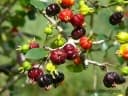
Eugenia uniflora
Eugenia uniflora
Safety & Hazards
The seeds are extremely resinous and toxic[1].
Cultivation Details
Eugenia uniflora succeeds in warm temperate to tropical areas, up to an elevation of 1,800 metres in the tropics[1]. The temperature range for growth is reported to be 12 - 32°c, with the optimum between 21 - 27°c[1]. It is rather cold-tolerant and will stand several degrees of frost unharmed, with older plants suffering only superficial injury at -5°c[1]. The annual rainfall range for growth is reported to be 700 - 2,700mm, with the optimum between 1,200 - 2,000mm[1]. It is well adapted to areas of high relative humidity but can also withstand a long dry season[1]. Prefers a fertile, moist soil in a sunny to partially shaded position[2]. Adaptable to a range of soil types, but intolerant of alkaline soils[3]. Succeeds in alkaline soils according to another report[4]. Prefers high levels of organic matter in the soil[3]. A position in full sun is required for the plant to maintain its best shape[2]. Plants are deep rooted and can withstand drought[1, 4]. Plants can become invasive in some areas, spreading by means of their roots[4]. A fairly slow-growing plant[5]. Flowering and fruiting may start when plants are 2 years old under favourable circumstances, usually it starts when 5 - 6 years old, on the flushes of the previous season or basal part of the shoots of the current season[1]. Flowering and fruiting continue over an extended period (6 - 8 weeks) and, depending on the climate, there may be several crops in a year[1] In India pruned bushes yielded 2.7 - 3.6 kg fruit per plant[1]. The highest yield obtained in Israel was 11 kg fruit from one untrimmed plant[1]. Two main types are distinguished: the most common form has bright cerise fruit and red-tinged foliage; the other form has dark-red to black berries and similarly tinted leaves; the latter form is rarer and tends to be sweeter and less resinous[1, 6]. There are several named varieties[7].
Propagation
Seed - keeps its viability for only about 1 month[1]. It is best sown as soon as it is ripe in a partially shaded position in individual containers. A germination rate of around 80 % can be expected, with the seed sprouting within 20 - 50 days[5]. Layering. Grafting Cite as: Tropical Plants Database, Ken Fern. tropical.theferns.info. 2026-02-20. <tropical.theferns.info/viewtropical.php?id=Eugenia+uniflora>
Pollinators
Data unavailable
References
- [1]World Agroforesty Centre — http://www.worldagroforestry.org/ ↩︎An excellent online database of a huge range of trees giving very good information on each plant - its uses, ecology, identity, propagation, pests etc.
- [2]Tropical Ornamentals; A Guide — Whistler. W. Arthur. · Timber Press Inc. Oregon. · 2000 · ISBN 0-88192-448-2 ↩︎An excellent little guide to some of the more commonly cultivated ornamental plants of the Tropics, often giving some information on the plants other uses.
- [3]The New RHS Dictionary of Gardening. 1992. — Huxley. A. · MacMillan Press · 1992 · ISBN 0-333-47494-5 ↩︎Excellent and very comprehensive, though it contains a number of silly mistakes. Readable yet also very detailed.
- [4]Tropical and Subtropical Trees - A Worldwide Encyclopaedic Guide. — Barwick. M. · Thames & Hudson, London · 2004 · ISBN 0-500-51181-0 ↩︎A superb book, very concise and well written, giving a wealth of information on 400 or more species including descriptions, habitat, cultivation details and plant uses. A wealth of colour photographs bring each plant vividly to life.
- [5]Brazilian Trees. Volume 1. 4th Edition. — Lorenzi. H. · Instituto Plantarum De Estudos Da Flora; Brazil. · 2002 · ISBN 85-86714-17-8 ↩︎Information on 350 species of Brazilian trees. Stunning photographs of each species, brief details on the plant, its uses and how to grow it from seed. A superb work, with the minor irritation that the translation from Portuguese is not of the best.
- [6]Brazilian Fruits and Cultivated Exotics — Lorenzi. H.; Bacher. L.; Lacerda. M.; Sartori. S. · Instituto Plantarum De Estudos Da Flora LTDA; Brazil. · 2000 · ISBN 85-867174-24-0 ↩︎A superb book, giving information on several hundred fruit species. Each entry has a brief description of the plant and its uses, accompanied by one to many excellent quality photographs of the fruits.
- [7]Cornucopia II — Facciola. S. · Kampong Publications, California. · 1998 · ISBN 0-9628087-2-5 ↩︎The second edition of an excellent guide to the edible uses of plants, though it does not give any details of cultivation etc.
- [8]Dictionary of Economic Plants. — Uphof. J. C. Th. · Weinheim · 1959 · ISBN - ↩︎An excellent and very comprehensive guide but it only gives very short descriptions of the uses without any details of how to utilize the plants. Not for the casual reader.
- [9]Tropical Food Gardens — Norrington. L. · Bloomings Books (Melbourne) · 2001 · ISBN 1-876473-41-x ↩︎Excellent little book giving some basic information on a range of plants.
- [10]Perennial Edible Fruits of the Tropics : an Inventory — Martin, F. W.; Campbell, C. W.; Rubertbe, R. M. · U.S. Dept. of Agriculture, Agricultural Research Service · 1987 ↩︎A booklet giving terse details of almost 300 species of edible fruits, plus regional lists of Botanical and Common names for over 2,500 less well-known edible fruits of the tropics.
- [11]Trees of Puerto Rico and the Virgin Islands. Second Volume. — Little E.L.; Woodbury R.O.;Wadsworth F.H. · USDA, Forest Service; Washington. · 1974 ↩︎Contains detailed information, and usually an illustration, on 500 tree species, including both native and exotic species.
- [12]Medicinal Plants of the Guianas — DeFilipps, R. A.; Maina, S. L.; & Crepin, J. · Smithsonian Museum · http://botany.si.edu/bdg/medicinal/index.html ↩︎A down-loadable PDF document of a book in pre-publication awaiting illustration. An excellent, if rather terse, guide to the traditional medicinal uses of the plants of the region