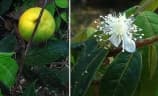
Eugenia stipitata
Eugenia stipitata
Safety & Hazards
None known
Cultivation Details
A plant of the moist to wet lowland tropics, where it is found at elevations up to 650 metres. It grows best in areas where annual daytime temperatures are within the range 22 - 30°c, but can tolerate 18 - 34°c[1]. It prefers a mean annual rainfall in the range 2,000 - 3,500mm, but tolerates 1,500 - 4,000mm[1]. It can tolerate a seasonal dry spell of up to 2 months[2]. Succeeds in full sun and light shade[1]. Prefers a well drained rich loamy soil, but will tolerate poorer clay oxisols, provided they are well drained, and also tolerates acid soil stress[2]. Prefers a pH in the range 5 - 6, tolerating 4.5 - 6.5[1]. The plant prefers a well-drained soil, but tolerates limited flooding - though some trees appear to adapt to floods over time[3]. A relatively slow-growing plant[2].
Propagation
Seed - pre-soaking the seeds in water or peeling them will help germination[3]. The seeds lose more than 70% of their viability after 40 days in cold storage[2]. Cite as: Tropical Plants Database, Ken Fern. tropical.theferns.info. 2026-02-20. <tropical.theferns.info/viewtropical.php?id=Eugenia+stipitata>
Pollinators
Data unavailable
References
- [1]Ecocrop — http://ecocrop.fao.org/ecocrop/srv/en/home ↩︎Basic information on a wide range of useful plants, plus details of environmental needs where available.
- [2]World Agroforesty Centre — http://www.worldagroforestry.org/ ↩︎An excellent online database of a huge range of trees giving very good information on each plant - its uses, ecology, identity, propagation, pests etc.
- [3]Rainforest Conservation Fund — http://www.rainforestconservation.org/data_sheets/agroforestry/index.html ↩︎Terse details on usage and Agroforestry notes, coupled with some good photos.
- [4]Trade Winds Fruit — http://www.tradewindsfruit.com/index.htm ↩︎The on-line catalogue of a company selling seeds. Gives descriptions, photos and uses of a very wide range of fruit and other food-producing plants plus ornamentals.
- [5]Brazilian Fruits and Cultivated Exotics — Lorenzi. H.; Bacher. L.; Lacerda. M.; Sartori. S. · Instituto Plantarum De Estudos Da Flora LTDA; Brazil. · 2000 · ISBN 85-867174-24-0 ↩︎A superb book, giving information on several hundred fruit species. Each entry has a brief description of the plant and its uses, accompanied by one to many excellent quality photographs of the fruits.
- [6]Mansfeld's Database of Agricultural and Horticultural Plants — http://mansfeld.ipk-gatersleben.de/pls/htmldb_pgrc/f?p=185:3:4292127278597336 ↩︎Terse details of a huge range of useful plants.
- [7]Fruit Trees and Useful Plants in Amazonian Life — Shanley P.; Cymerys M.; Serra M.; Medina G. (Editors) · FAO, United Nations · 2011 · http://www.fao.org/docrep/015/i2360e/i2360e.pdf · ISBN 978-92-5-107007-9 ↩︎Quite a lot of information on a number of useful plants growing in the Amazon. It can be downloaded from the Internet.
- [8]IUCN Red List of Threatened Species — http://www.iucnredlist.org/ ↩︎A list of plants under threat and facing possible extinction, usually with brief details of the threats and information on habitat.
- [9]Food Plants in the Americas: A Survey of the Domesticated, Cultivated, and Wild Plants Used for Human Food in North, — Kermath B.M.; Bennett B.C.' Pulsipher L.M. · 2014 ↩︎A pre-publication draft of an amazing, on-going work first started in 1985. It contains information on more than 3,900 taxa from the Americas - from Arctic regions to the Tropics
- [10]Enciclopedia de las Plantas Útiles del Ecuador — de la Torre, L., Navarrete H., P. Muriel M., Macía M.J. & Ba · Herbario QCA de la Escuela de Ciencias Biológicas de la Pontific · 2008 · ISBN 978-9978-77-135-8 ↩︎
- [11]Cornucopia II — Facciola. S. · Kampong Publications, California. · 1998 · ISBN 0-9628087-2-5 ↩︎The second edition of an excellent guide to the edible uses of plants, though it does not give any details of cultivation etc.
- [PFAF]Plants for a Future — pfaf.org ↩︎