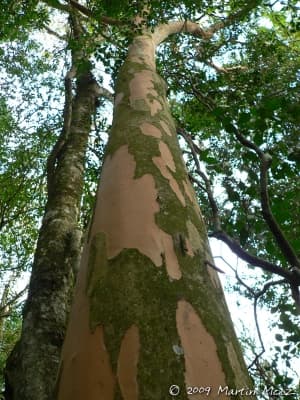
Eugenia pyriformis
Eugenia pyriformis
Safety & Hazards
None known
Cultivation Details
A plant of drier areas in the tropics and subtropics, where it is found at elevations from 300 - 1,500 metres. It grows best in areas where annual daytime temperatures are within the range 20 - 26°c, but can tolerate 15 - 30°c[1]. Plants are tolerant of occasional light frosts[2]. It prefers a mean annual rainfall in the range 450 - 600mm, but tolerates 300 - 800mm[1]. Succeeds in full sun or part day shade[3]. Adaptable to a range of soil types, but intolerant of alkaline soils[3]. Prefers a well-drained soil[1]. Prefers a pH in the range 6 - 7, tolerating 5 - 8[1]. Prefers high levels of organic matter in the soil[3]. Established plants are drought tolerant[2]. A slow-growing plant, rarely reaching 2 metres tall after 2 years[4]. Seedling plants can start producing fruit when 3 - 4 years old[2].
Propagation
Seed - it has a viability of 60 days or less and so is best sown as soon as it is ripe in a partially shaded position in individual containers. A germination rate of around 40% can be expected, with the seed sprouting within 10 - 40 days[4]. Seedlings are quite slow to develop, but should be ready to plant out 10 - 11 months later[4]. Cite as: Tropical Plants Database, Ken Fern. tropical.theferns.info. 2026-02-20. <tropical.theferns.info/viewtropical.php?id=Eugenia+pyriformis>
Pollinators
Data unavailable
References
- [1]Ecocrop — http://ecocrop.fao.org/ecocrop/srv/en/home ↩︎Basic information on a wide range of useful plants, plus details of environmental needs where available.
- [2]Perennial Edible Fruits of the Tropics : an Inventory — Martin, F. W.; Campbell, C. W.; Rubertbe, R. M. · U.S. Dept. of Agriculture, Agricultural Research Service · 1987 ↩︎A booklet giving terse details of almost 300 species of edible fruits, plus regional lists of Botanical and Common names for over 2,500 less well-known edible fruits of the tropics.
- [3]The New RHS Dictionary of Gardening. 1992. — Huxley. A. · MacMillan Press · 1992 · ISBN 0-333-47494-5 ↩︎Excellent and very comprehensive, though it contains a number of silly mistakes. Readable yet also very detailed.
- [4]Brazilian Trees. Volume 1. 4th Edition. — Lorenzi. H. · Instituto Plantarum De Estudos Da Flora; Brazil. · 2002 · ISBN 85-86714-17-8 ↩︎Information on 350 species of Brazilian trees. Stunning photographs of each species, brief details on the plant, its uses and how to grow it from seed. A superb work, with the minor irritation that the translation from Portuguese is not of the best.
- [5]Brazilian Fruits and Cultivated Exotics — Lorenzi. H.; Bacher. L.; Lacerda. M.; Sartori. S. · Instituto Plantarum De Estudos Da Flora LTDA; Brazil. · 2000 · ISBN 85-867174-24-0 ↩︎A superb book, giving information on several hundred fruit species. Each entry has a brief description of the plant and its uses, accompanied by one to many excellent quality photographs of the fruits.
- [6]Dictionary of Economic Plants. — Uphof. J. C. Th. · Weinheim · 1959 · ISBN - ↩︎An excellent and very comprehensive guide but it only gives very short descriptions of the uses without any details of how to utilize the plants. Not for the casual reader.
- [7]Mansfeld's Database of Agricultural and Horticultural Plants — http://mansfeld.ipk-gatersleben.de/pls/htmldb_pgrc/f?p=185:3:4292127278597336 ↩︎Terse details of a huge range of useful plants.
- [8]IUCN Red List of Threatened Species — http://www.iucnredlist.org/ ↩︎A list of plants under threat and facing possible extinction, usually with brief details of the threats and information on habitat.
- [9]Diccionario das Plantas Uteis do Brasil — Correa M.P. · Imprensa Nacional; Rio de Janeiro · 1926 ↩︎A massive work in 6 volumes giving details of the various uses of Brazilian plants.
- [10]Food Plants in the Americas: A Survey of the Domesticated, Cultivated, and Wild Plants Used for Human Food in North, — Kermath B.M.; Bennett B.C.' Pulsipher L.M. · 2014 ↩︎A pre-publication draft of an amazing, on-going work first started in 1985. It contains information on more than 3,900 taxa from the Americas - from Arctic regions to the Tropics