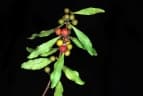
Euclea divinorum
Euclea divinorum
Safety & Hazards
None known
Cultivation Details
A plant of drier areas in the tropics and subtropics, where it can be found at elevations up to 2,400 metres. It grows best in areas where the mean annual temperatures are around 17°c, and the mean annual rainfall around 700mm[1]. Prefers mesic calcareous valley clays and sometimes rocky ground[1]. Moderately tolerant of heavy metals in the soil, tolerating high concentrations of nickel, but only relatively low levels of copper, and often becomes locally abundant on metalliferous soils. It is particularly common on arsenical soils[2]. The plant has a good coppicing ability and root suckers are common, growing up some distance from the tree[2]. Plants tends to dominate pastures to the detriment of wildlife and pastoralism. In some situations only the use of arboricides can solve the problem[2]. A dioecious species, both male and female forms need to be grown if fruit and seeds are required[1].
Propagation
Seed - no pre-treatment is necessary[2]. Fresh seed germinates readily[2]. The seed only has a short viability in normal store, losing viability within about 2 months[2]. Suckers. Cite as: Tropical Plants Database, Ken Fern. tropical.theferns.info. 2026-02-20. <tropical.theferns.info/viewtropical.php?id=Euclea+divinorum>
Pollinators
Data unavailable
References
- [1]World Agroforesty Centre — http://www.worldagroforestry.org/ ↩︎An excellent online database of a huge range of trees giving very good information on each plant - its uses, ecology, identity, propagation, pests etc.
- [2]Protabase - Plant Resources of Tropical Africa. — http://www.prota.org ↩︎An excellent on-line database with detailed information on over 3,200 species of useful plants of Africa.
- [3]Field Guide to the Moist Forest Trees of Tanzania. — Lovett J.C.; Ruffo C.K.; Gereau R.E.; Taplin J.R.D · Frontier · http://www.york.ac.uk/res/celp/webpages/projects/ecology/tree%20guide/introduction.htm · ISBN 1-873070-33-0 ↩︎A lovely little book giving a basic identification guide to more than 650 species of trees growing in Tanzania. It is also available to view on the internet.