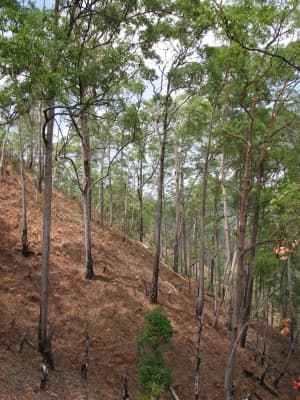
Eucalyptus urophylla
Eucalyptus urophylla
Safety & Hazards
None known
Cultivation Details
Eucalyptus urophylla is a plant of humid and sub-humid tropical areas, where it is found at elevations from sea level up to 3,000 metres[1]. It is found in areas with a mean annual temperature of 24 - 28°c and a mean annual rainfall of 700 - 2,500 mm[1]. In its natural range the rainfall is monsoonal with 2 - 8 dry months per year[2]. Develops best on deep, moist, well-drained, acidic or neutral soils derived from volcanic or metamorphic rock[1]. It is also commonly found on basalt, schist and slates, but rarely on limestone[1]. It tolerates poor soils as long as the texture is loose[2]. A fast-growing tree, especially when young. Trees in one planting had reached an average height of 27 metres when 8 years old[3]. Flowering usually starts within 2 years from planting[1], and good seed production starts around the age of 4 years[3].. The tree has good coppicing ability and can be expected to produce at least 3 coppice rotations after the initial seedling rotation[1]. Eucalyptus species have not adopted a deciduous habit and continue to grow until it is too cold for them to do so. This makes them more susceptible to damage from sudden cold snaps. If temperature fluctuations are more gradual, as in a woodland for example, the plants have the opportunity to stop growing and become dormant, thus making them more cold resistant. A deep mulch around the roots to prevent the soil from freezing also helps the trees to survive cold conditions. The members of this genus are remarkably adaptable however, there can be a dramatic increase in the hardiness of subsequent generations from the seed of survivors growing in temperate zones[4]. Eucalyptus monocultures are an environmental disaster, they are voracious, allelopathic and encourage the worst possible attitudes to land use and conservation[4].
Propagation
Seed - surface sow in a sunny position and make sure the compost is not allowed to dry out[5, 6, 7]. Species that come from high altitudes appreciate 6 - 8 weeks cold stratification at 2°c[4]. Pot up the seedlings into individual pots as soon as the second set of seed leaves has developed, if left longer than this they might not move well[4]. The seedlings are ready for planting in the field when they are 25 - 30 cm tall, usually after 10 - 12 weeks[3]. The seed has a long viability[4]. Rooted cuttings derived from stump sprouts are also used in raising E. Urophylla. After coppicing, when the new sprouts are 60 - 80 cm long, they are removed and divided into cuttings with 2 pairs of leaves[1]. In Indonesia, tissue culture has proved successful on an experimental scale[1]. Cite as: Tropical Plants Database, Ken Fern. tropical.theferns.info. 2026-02-20. <tropical.theferns.info/viewtropical.php?id=Eucalyptus+urophylla>
Pollinators
Insects, Birds
References
- [1]World Agroforesty Centre — http://www.worldagroforestry.org/ ↩︎An excellent online database of a huge range of trees giving very good information on each plant - its uses, ecology, identity, propagation, pests etc.
- [2]Seed Leaflets — Various · Forest & Landscape. Denmark · http://en.sl.life.ku.dk/Publikationer/Udgivelser/PopulaerPublikationer.aspx?katid={D28373CC-6EF3-4EF8-B097-6D83FABF209E}&serieid={9F1C3DB1-6E7B-4CF1-AF53-F480B0CB40EF}&sort=title ↩︎A series of leaflets, jointly produced by the University of Copenhagen and the Royal Botanic Gardens at Kew, focussing on seed information for a number species, but also giving a lot of other information about each plant.
- [3]Plant Resources of Southeast Asia — http://proseanet.org/ ↩︎Lots of information on the uses of the plants of SE Asia.
- [4]The New RHS Dictionary of Gardening. 1992. — Huxley. A. · MacMillan Press · 1992 · ISBN 0-333-47494-5 ↩︎Excellent and very comprehensive, though it contains a number of silly mistakes. Readable yet also very detailed.
- [5]Trees and Shrubs Hardy in Great Britain. Vol 1 - 4 and Supplement. — Bean. W. · Murray · 1981 · ISBN - ↩︎A classic with a wealth of information on the plants, but poor on pictures.
- [6]Propagation of Trees, Shrubs and Conifers. — Sheat. W. G. · MacMillan and Co · 1948 · ISBN - ↩︎A bit dated but a good book on propagation techniques with specific details for a wide range of plants.
- [7]Growing from Seed. Volume 2. — Rice. G. (Editor) · Thompson and Morgan. · 1988 · ISBN - ↩︎Very readable magazine with lots of information on propagation. An interesting article on Ensete ventricosum.
- [8]Eucalyptus Leaf Oils: Use, Chemistry, Distillation and Marketing — Southwell I.A. · 1992 · https://doi.org/10.1016/0031-9422(92)80403-2 ↩︎An extensive list of Eucalyptus species and their essential oil content.