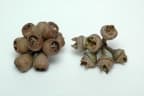
Eucalyptus saligna
Eucalyptus saligna
Safety & Hazards
None known
Cultivation Details
The preferred climate is warm temperate to subtropical with a mild dry season of not more than 4 months, although Eucalyptus saligna has also proved to be highly suited for short-rotation plantations in tropical montane regions[1]. In its native range it is found at elevations from sea level to 1,220 metres, whilst in the tropics trees have succeeded at elevations up to 1,980 metres[1]. Trees at the higher elevations in its native range have experienced temperatures as low as -15°c and up to 15 frosts a year[1, 2]. Mean annual rainfall in its native range varies from 800 - 1,270 mm, though in the tropics it has succeeded with up to 7,620mm of rain[1, 2]. Although it can tolerate short dry periods, best growth is achieved on sites with a high rainfall well distributed throughout the year[1]. The tree achieves its best growth on sites with about 2,540 mm annual rainfall, rather than on wetter sites, possibly because sunlight is greatly reduced by the cloud cover on wetter sites[1]. Requires a position in full sun[1]. Prefers a moist but well drained soil[1]. Best development occurs on good quality, alluvial sandy loams, the tree also succeeding on podsols and volcanic loams[1]. The plant develops a lignotuber - this is a woody tuber that starts to develop near the base of seedlings and can become massive in the mature plants of some species. It possesses embedded vegetative buds, allowing the plant to regenerate following crown destruction, for example by fire[3]. Whilst most Eucalyptus species, grown in small numbers outside their native range, can be an attractive and useful addition to the landscape, certain species (including this one) are more problematic. When grown in monocultures, especially outside their native range, they can become an environmental disaster. They are voracious, especially in their use of water; they are allelopathic, inhibiting the growth of the native flora; they reduce habitats for native fauna; and encourage the worst possible attitudes to land use and conservation[4]. Seed production commences when the tree is about 7 - 8 years old[1]. Coppices, with rotations of 6 - 10 years are used for producing fuel wood and pulpwood[1]. Annual wood production potential is 15 - 35 cubic metres per hectare[5]. This fast-growing, light-demanding tree is highly sensitive to competition from weeds during the first 2 years, and therefore measures to control emerging weed growth must be carried out several times. The rapid early growth soon allows the tree to dominate competing vegetation[1]. The glabrous leaves are aromatic when crushed[1]. Eucalyptus species have not adopted a deciduous habit and continue to grow until it is too cold for them to do so. This makes them more susceptible to damage from sudden cold snaps. If temperature fluctuations are more gradual, as in a woodland for example, the plants have the opportunity to stop growing and become dormant, thus making them more cold resistant. A deep mulch around the roots to prevent the soil from freezing also helps the trees to survive cold conditions[4]. Many members of this genus are remarkably adaptable however, and there can be a dramatic increase in the hardiness of subsequent generations from the seed of survivors growing in temperate zones[4].
Propagation
Seed - surface sow late winter/early spring in a sunny position in a greenhouse[6, 7, 8]. Species that come from high altitudes appreciate 6 - 8 weeks cold stratification at 2°c[4]. Pot up the seedlings into individual pots as soon as the second set of seed leaves has developed, if left longer than this they might not move well. Plant out into their permanent positions in early summer and give them some protection from the cold in their first winter. The seed can also be sown in early summer, the young trees being planted in their final positions in late spring of the following year. The seed has a long viability[4]. Cite as: Temperate Plants Database, Ken Fern. temperate.theferns.info. 2026-02-21. <temperate.theferns.info/plant/Eucalyptus+saligna>
Pollinators
Bees, Insects
References
- [1]World Agroforesty Centre — http://www.worldagroforestry.org/ ↩︎An excellent online database of a huge range of trees giving very good information on each plant - its uses, ecology, identity, propagation, pests etc.
- [2]Eucalypts for Planting — Jacobs M.R. · FAO; Rome · 1981 · http://www.fao.org · ISBN 92-5-100570-2 ↩︎An excellent publication, rather dated now but with a wealth of information about the Eucalypts. It can be downloaded from the Internet as a PDF file.
- [3]EUCLID - Eucalypts of Australia — Centre for Australian National Biodiversity Research, Canber · http://keyserver.lucidcentral.org:8080/euclid/data/02050e02-0108-490e-8900-0e0601070d00/media/Html/index.htm ↩︎A website dedicated to the genus Eucalyptus (sensu latu), with descriptions and nomencultural information on all the species.
- [4]The New RHS Dictionary of Gardening. 1992. — Huxley. A. · MacMillan Press · 1992 · ISBN 0-333-47494-5 ↩︎Excellent and very comprehensive, though it contains a number of silly mistakes. Readable yet also very detailed.
- [5]Ecocrop — http://ecocrop.fao.org/ecocrop/srv/en/home ↩︎Basic information on a wide range of useful plants, plus details of environmental needs where available.
- [6]Trees and Shrubs Hardy in Great Britain. Vol 1 - 4 and Supplement. — Bean. W. · Murray · 1981 · ISBN - ↩︎A classic with a wealth of information on the plants, but poor on pictures.
- [7]Propagation of Trees, Shrubs and Conifers. — Sheat. W. G. · MacMillan and Co · 1948 · ISBN - ↩︎A bit dated but a good book on propagation techniques with specific details for a wide range of plants.
- [8]Growing from Seed. Volume 2. — Rice. G. (Editor) · Thompson and Morgan. · 1988 · ISBN - ↩︎Very readable magazine with lots of information on propagation. An interesting article on Ensete ventricosum.
- [9]Handbook of Energy Crops — Duke. J. · - · 1983 · https://hort.purdue.edu/newcrop/duke_energy/dukeindex.html · ISBN - ↩︎Published only on the Internet, excellent information on a wide range of both temperate and tropical plants.
- [10]Pacific Island Ecosystems at Risk — http://www.hear.org/pier/scientificnames/index.html ↩︎A very good website detailing weed species that have been introduced into the Pacific Islands.
- [11]Flora of New South Wales — http://plantnet.rbgsyd.nsw.gov.au/floraonline.htm ↩︎An on-line resource giving a brief botanical description of all the native plants of New South Wales, their habitat and range, together with diagrams and photographs of the plants.
- [12]The Useful Native Plants of Australia. — Maiden J.H. · Turner & Co.; London. · 1889 · http://www.biodiversitylibrary.org ↩︎Terse details of the uses of many Australian plants and other species naturalised, or at least growing, in Australia. It can be downloaded from the Internet.
- [13]Native Tastes of Australia — http://tasteaustralia.biz/ ↩︎A website with detailed information on around 50 species of native Australian food plants, including recipes.