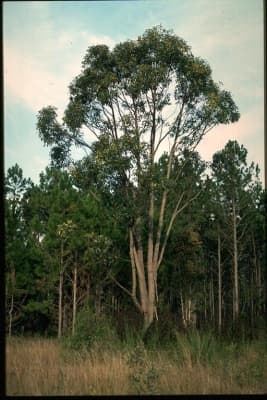
Eucalyptus robusta
Eucalyptus robusta
Safety & Hazards
None known
Cultivation Details
Eucalyptus robusta is a plant of the lowland subtropics but, remarkably, it can adapt to a wide variety of conditions, from equatorial regions with maximum temperatures of about 35°c, to more temperate climates where it can endure frost, provided the frosts are not severe[1]. It grows naturally at elevations up to 100 metres in areas where the mean maximum temperature in the hottest month is 30 - 32°c, and the mean minimum of the coldest month is about 3 - 5°c[1]. Throughout its native range, from 5 to 10 light frosts occur each year[1]. It has proved to be very adaptable in the tropics, where it can grow from sea level to elevations of 1,100 metres with a mean annual rainfall that ranges from 1,000 - 6,350 mm[1]. Requires a sunny position[1]. Succeeds on a range of soils, but prefers stiff clays and leached sandy loams[1]. The tree is exceedingly tolerant to prolonged flooding, so it is extensively planted in swampy areas and along rivers[1]. Tolerant of very acid soils[2]. Whilst most Eucalyptus species, grown in small numbers outside their native range, can be an attractive and useful addition to the landscape, certain species (including this one) are more problematic. When grown in monocultures, especially outside their native range, they can become an environmental disaster. They are voracious, especially in their use of water; they are allelopathic, inhibiting the growth of the native flora; they reduce habitats for native fauna; and encourage the worst possible attitudes to land use and conservation[3]. Trees start flowering when they are 3 - 5 years old. Seed dispersal is mainly by wind. The tree regenerates freely, and dense thickets of saplings can be found near old stands[4]. A fast growing tree, it has reached a height of 27 metres in 15 years from seed in tropical plantations[5]. The annual growth in height is usually 1.8 - 2.4 metres during the first few years, slowing down to 1.5 - 1.8 metres later[4]. The plant grows well in plantations on good sites, but because of its ability to grow on both poorly drained and draughty locations, it is usually planted on adverse sites[1]. It regenerates in areas flooded with fresh water, and its roots appear to be able to penetrate the heavy clays found in these conditions to reach the aerated soils below[1]. The growth habit also helps it to establish on difficult but not necessarily flooded soils in localities widely different from its normal habitat[1]. The tree can send out aerial roots from its trunk[1]. Plants coppice well up to the age of 25 years[1]. It recovers well from fire, sending out shoots from relatively small branches a few centimetres in diameter[1]. Under optimal conditions, the tree begins flowering by the end of its third growing season. More commonly, trees begin flowering when they are 5 years old[1]. In tropical areas, such as Hawaii and Puerto Rico, flowers may appear at almost any time of the year[1]. Planted seedlings are susceptible to competition and shading, and generally require two weedings in the first six months[1]. The length of rotation is largely determined by the product desired. For fuel wood, the tree is sometimes grown in plantations on a 4 - 5 year rotation; for pulpwood an 8 - 10 year rotation is appropriate; whilst saw logs can be produced in plantations or natural stands using 30 - 60 year rotations[1]. Most Eucalyptus robusta plantations are regenerated from coppice shoots. The leaves are aromatic and, when crushed, have a spicy, resinous odour[1]. Eucalyptus species have not adopted a deciduous habit and continue to grow until it is too cold for them to do so. This makes them more susceptible to damage from sudden cold snaps. If temperature fluctuations are more gradual, as in a woodland for example, the plants have the opportunity to stop growing and become dormant, thus making them more cold resistant. A deep mulch around the roots to prevent the soil from freezing also helps the trees to survive cold conditions[3]. Many members of this genus are remarkably adaptable however, and there can be a dramatic increase in the hardiness of subsequent generations from the seed of survivors growing in temperate zones[3].
Propagation
Seed - surface sow late winter/early spring in a sunny position in a greenhouse[6, 7, 8]. Species that come from high altitudes appreciate 6 - 8 weeks cold stratification at 2°c[3]. Pot up the seedlings into individual pots as soon as the second set of seed leaves has developed, if left longer than this they might not move well. Plant out into their permanent positions in early summer and give them some protection from the cold in their first winter. The seed can also be sown in early summer, the young trees being planted in their final positions in late spring of the following year. The seed has a long viability[3]. Cite as: Temperate Plants Database, Ken Fern. temperate.theferns.info. 2026-02-21. <temperate.theferns.info/plant/Eucalyptus+robusta>
Pollinators
Bees, Insects
References
- [1]World Agroforesty Centre — http://www.worldagroforestry.org/ ↩︎An excellent online database of a huge range of trees giving very good information on each plant - its uses, ecology, identity, propagation, pests etc.
- [2]Medicinal Plants in the Republic of Korea — World Health Organisation, Manila · 1998 · ISBN 92 9061 120 0 ↩︎An excellent book with terse details about the medicinal uses of the plants with references to scientific trials. All plants are described, illustrated and brief details of habitats given.
- [3]The New RHS Dictionary of Gardening. 1992. — Huxley. A. · MacMillan Press · 1992 · ISBN 0-333-47494-5 ↩︎Excellent and very comprehensive, though it contains a number of silly mistakes. Readable yet also very detailed.
- [4]Protabase - Plant Resources of Tropical Africa. — http://www.prota.org ↩︎An excellent on-line database with detailed information on over 3,200 species of useful plants of Africa.
- [5]Silvics of North America. Agricultural Handbook No. 654. — Burns. R.M. & Honkala. B.H. · USDA Forest Service; Washington DC. · 1990 · http://www.na.fs.fed.us/spfo/pubs/silvics_manual/table_of_contents.htm ↩︎A very comprehensice guide to about 200 species of timber trees of N. America, Hawaii and Puerto Rico. Mainly temperate species, plus a number of tropical species. It is downloadable from the Internet.
- [6]Trees and Shrubs Hardy in Great Britain. Vol 1 - 4 and Supplement. — Bean. W. · Murray · 1981 · ISBN - ↩︎A classic with a wealth of information on the plants, but poor on pictures.
- [7]Propagation of Trees, Shrubs and Conifers. — Sheat. W. G. · MacMillan and Co · 1948 · ISBN - ↩︎A bit dated but a good book on propagation techniques with specific details for a wide range of plants.
- [8]Growing from Seed. Volume 2. — Rice. G. (Editor) · Thompson and Morgan. · 1988 · ISBN - ↩︎Very readable magazine with lots of information on propagation. An interesting article on Ensete ventricosum.
- [9]The Useful Native Plants of Australia. — Maiden J.H. · Turner & Co.; London. · 1889 · http://www.biodiversitylibrary.org ↩︎Terse details of the uses of many Australian plants and other species naturalised, or at least growing, in Australia. It can be downloaded from the Internet.