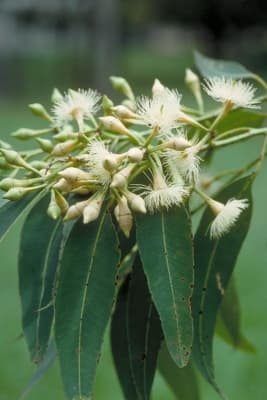
Eucalyptus pellita
Eucalyptus pellita
Safety & Hazards
None known
Cultivation Details
Eucalyptus pellita is found in two widely separated areas of Australia. In the tropical climate of Queensland it is found at latitudes 12 - 18°S, whilst in the subtropics of New South Wales it is found at 27 - 36°S. It grows best in areas where the mean annual temperature ranges from a cool month of 4 - 19°c to a hot month of 24 - 34°c; the mean annual rainfall is within the range 900 - 4,000mm and there is all year round or summer rainfall. The species, especially when obtained from its southern provenance, is moderately frost resistant[1]. Requires a sunny position[2]. Grows best in well-drained soils ranging from shallow sands on sandstone ridges to shallow sandy podzols and deep forest loams[1]. Prefers a pH in the range 6 - 7, tolerating 5.5 - 7.5[2]. The plant develops a lignotuber - this is a woody tuber that starts to develop near the base of seedlings and can become massive in the mature plants of some species. It possesses embedded vegetative buds, allowing the plant to regenerate following crown destruction, for example by fire[3]. A fast-growing tree, it can reach a height of 13 - 15 metres in 3.5 years, and an be grown on 4 - 8 years coppice rotations[2]. Whilst most Eucalyptus species, grown in small numbers outside their native range, can be an attractive and useful addition to the landscape, certain species (including this one) are more problematic. When grown in monocultures, especially outside their native range, they can become an environmental disaster. They are voracious, especially in their use of water; they are allelopathic, inhibiting the growth of the native flora; they reduce habitats for native fauna; and encourage the worst possible attitudes to land use and conservation[4]. Recommended for planting only on well-drained, sandy soils where at an early stage it forms a dense crown that shades out weeds once it is established[1].
Propagation
Seed - no pre-treatment is required[1]. Surface sow in a sunny position and make sure the compost is not allowed to dry out[5, 6, 7]. Species that come from high altitudes appreciate 6 - 8 weeks cold stratification at 2°c[4]. Pot up the seedlings into individual pots as soon as the second set of seed leaves has developed, if left longer than this they might not move well. The seedlings are ready for planting in the field when they are 25 - 30 cm tall, usually after 3 - 4 months. The seed has a long viability[4]. Cite as: Tropical Plants Database, Ken Fern. tropical.theferns.info. 2026-02-20. <tropical.theferns.info/viewtropical.php?id=Eucalyptus+pellita>
Pollinators
Bees, Insects
References
- [1]World Agroforesty Centre — http://www.worldagroforestry.org/ ↩︎An excellent online database of a huge range of trees giving very good information on each plant - its uses, ecology, identity, propagation, pests etc.
- [2]Ecocrop — http://ecocrop.fao.org/ecocrop/srv/en/home ↩︎Basic information on a wide range of useful plants, plus details of environmental needs where available.
- [3]EUCLID - Eucalypts of Australia — Centre for Australian National Biodiversity Research, Canber · http://keyserver.lucidcentral.org:8080/euclid/data/02050e02-0108-490e-8900-0e0601070d00/media/Html/index.htm ↩︎A website dedicated to the genus Eucalyptus (sensu latu), with descriptions and nomencultural information on all the species.
- [4]The New RHS Dictionary of Gardening. 1992. — Huxley. A. · MacMillan Press · 1992 · ISBN 0-333-47494-5 ↩︎Excellent and very comprehensive, though it contains a number of silly mistakes. Readable yet also very detailed.
- [5]Trees and Shrubs Hardy in Great Britain. Vol 1 - 4 and Supplement. — Bean. W. · Murray · 1981 · ISBN - ↩︎A classic with a wealth of information on the plants, but poor on pictures.
- [6]Propagation of Trees, Shrubs and Conifers. — Sheat. W. G. · MacMillan and Co · 1948 · ISBN - ↩︎A bit dated but a good book on propagation techniques with specific details for a wide range of plants.
- [7]Growing from Seed. Volume 2. — Rice. G. (Editor) · Thompson and Morgan. · 1988 · ISBN - ↩︎Very readable magazine with lots of information on propagation. An interesting article on Ensete ventricosum.