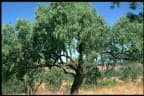
Eucalyptus microtheca
Eucalyptus microtheca
Safety & Hazards
None known
Cultivation Details
Eucalyptus microtheca is a plant of the arid and semiarid tropics and subtropics, where it is found at elevations up to 1,000 metres. It grows best in areas where annual daytime temperatures are within the range 24 - 39°c, but can tolerate 5 - 45°c[1]. It can be killed by temperatures of -4°c or lower, though new growth will be damaged if the temperature falls to zero[1]. It prefers a mean annual rainfall in the range 250 - 1,000mm, but tolerates 150 - 1,200mm[1]. Requires a sunny position[1]. Succeeds in most soils of at least moderate fertility[1]. Prefers a pH in the range 6.5 - 8, tolerating 6 - 9[1]. The plant often experiences inundation for part of the year and is also able to withstand up to 7 months drought[1]. The plant develops a lignotuber - this is a woody tuber that starts to develop near the base of seedlings and can become massive in the mature plants of some species. It possesses embedded vegetative buds, allowing the plant to regenerate following crown destruction, for example by fire[2]. A potentially very fast-growing species if there is sufficient water, on suitable sites the growth may reach 3 metres per year[1]. Under irrigation it should be possible to grow the tree in deserts[1]. The tree can be harvested after 8 years from a seedling crop and after 6 years from subsequent coppice crops[1]. Annual wood production potential is 3 - 7 cubic metres per hectare[1]. The tree is fire tender[1].
Propagation
Seed - surface sow in a sunny position and make sure the compost is not allowed to dry out[3, 4, 5]. Species that come from high altitudes appreciate 6 - 8 weeks cold stratification at 2°c[6]. Pot up the seedlings into individual pots as soon as the second set of seed leaves has developed, if left longer than this they might not move well. The seedlings are ready for planting in the field when they are 25 - 30 cm tall, usually after 3 - 4 months. The seed has a long viability[6]. Cite as: Tropical Plants Database, Ken Fern. tropical.theferns.info. 2026-02-20. <tropical.theferns.info/viewtropical.php?id=Eucalyptus+microtheca>
Pollinators
Bees, Insects
References
- [1]Ecocrop — http://ecocrop.fao.org/ecocrop/srv/en/home ↩︎Basic information on a wide range of useful plants, plus details of environmental needs where available.
- [2]EUCLID - Eucalypts of Australia — Centre for Australian National Biodiversity Research, Canber · http://keyserver.lucidcentral.org:8080/euclid/data/02050e02-0108-490e-8900-0e0601070d00/media/Html/index.htm ↩︎A website dedicated to the genus Eucalyptus (sensu latu), with descriptions and nomencultural information on all the species.
- [3]Trees and Shrubs Hardy in Great Britain. Vol 1 - 4 and Supplement. — Bean. W. · Murray · 1981 · ISBN - ↩︎A classic with a wealth of information on the plants, but poor on pictures.
- [4]Propagation of Trees, Shrubs and Conifers. — Sheat. W. G. · MacMillan and Co · 1948 · ISBN - ↩︎A bit dated but a good book on propagation techniques with specific details for a wide range of plants.
- [5]Growing from Seed. Volume 2. — Rice. G. (Editor) · Thompson and Morgan. · 1988 · ISBN - ↩︎Very readable magazine with lots of information on propagation. An interesting article on Ensete ventricosum.
- [6]The New RHS Dictionary of Gardening. 1992. — Huxley. A. · MacMillan Press · 1992 · ISBN 0-333-47494-5 ↩︎Excellent and very comprehensive, though it contains a number of silly mistakes. Readable yet also very detailed.
- [7]Flora of South-eastern Queensland (3 volumes) — Stanley T.D. & Ross E.M. · Queensland Government; Queensland · 1983 · ISBN 0-7242-2127-1 ↩︎
- [8]Cornucopia II — Facciola. S. · Kampong Publications, California. · 1998 · ISBN 0-9628087-2-5 ↩︎The second edition of an excellent guide to the edible uses of plants, though it does not give any details of cultivation etc.
- [9]The Useful Native Plants of Australia. — Maiden J.H. · Turner & Co.; London. · 1889 · http://www.biodiversitylibrary.org ↩︎Terse details of the uses of many Australian plants and other species naturalised, or at least growing, in Australia. It can be downloaded from the Internet.
- [10]Native Tastes of Australia — http://tasteaustralia.biz/ ↩︎A website with detailed information on around 50 species of native Australian food plants, including recipes.
- [11]Eucalyptus Leaf Oils: Use, Chemistry, Distillation and Marketing — Southwell I.A. · 1992 · https://doi.org/10.1016/0031-9422(92)80403-2 ↩︎An extensive list of Eucalyptus species and their essential oil content.
- [PFAF]Plants for a Future — pfaf.org ↩︎