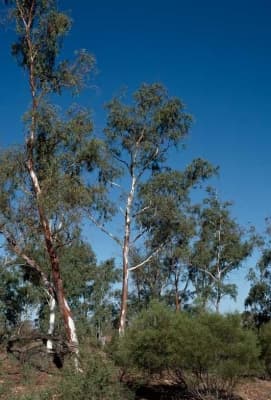
Eucalyptus camaldulensis
Eucalyptus camaldulensis
Safety & Hazards
None known
Cultivation Details
Eucalyptus camaldulensis is a plant of low to moderate elevations in tropical, subtropical and warm temperate areas where it is found at elevations from sea level to 1,500 metres[1]. It grows in areas where the mean annual precipitation is in the range of 250 - 2,500mm and an annual temperature range of 3 - 22°c minimum to 21 - 40°c maximum[2, 1]. A fairly frost resistant species, plants from some provenances are known to survive temperatures down to at least -7°c in Australian gardens[3, 4]. The tree is reported to grow in areas with only 200mm rainfall, but the lower limit for commercial plantations is 400mm[2]. The dry season can last 4 - 8 months or more and may be severe, though for the tree to still flourish in such conditions it needs access to ground water[2, 5]. Prefers a sunny position in a moderately fertile well-drained moisture retentive circum-neutral soil[6]. Succeeds in most soils[7], growing well in heavy clays and also tolerating poor and dry soils, especially those low in mineral elements[6, 8]. Some provenances tolerate many different soil conditions such as high calcium, high salt and periodic water-logging[2]. The plant prefers a pH in the range 5 - 7, tolerating 4.5 - 8[9]. A drought resistant tree once established[3, 6], it is slightly salt tolerant[3], and can also withstand periodic inundation[3]. A very fast growing tree[3]. On the very best of sites annual growth rates of 4 - 7 metres have been recorded with 4 - 6cm increases in diameter; but on drier sites annual growth of around 120cm is more common[10]. Some provenances coppice well for six or more rotations, on good sites, plantations are managed on coppice rotations of 7 - 10 years[2]. According to NAS (1980a), annual wood yields are around 20 - 25 cubic metres per hectare in Argentina, around 30 cubic metres from Israel, 17 - 20 cubic metres from Turkey in the first rotation, rising to 25 - 30 cubic metres in subsequent coppice rotations[2]. On poor arid sites yields are only 2 - 11 cubic metres on 14 or 15 year rotations[2]. Trees can start flowering when less than 2 years old and in suitable climates will flower and produce seed all year round[10]. Eucalyptus species have not adopted a deciduous habit and continue to grow until it is too cold for them to do so. This makes them more susceptible to damage from sudden cold snaps. If temperature fluctuations are more gradual, as in a woodland for example, the plants have the opportunity to stop growing and become dormant, thus making them more cold resistant. A deep mulch around the roots to prevent the soil from freezing also helps the trees to survive cold conditions[6]. Many members of this genus are remarkably adaptable however, and there can be a dramatic increase in the hardiness of subsequent generations from the seed of survivors growing in temperate zones[6]. Trees are liable to shed branches, especially in hot weather[7]. This is said to be the most widely distributed eucalyptus tree in Australia, ranging over 23° of latitude. It is found in most of arid and semiarid Australia but not the humid eastern and south-western coasts[11, 12]. Whilst most Eucalyptus species, grown in small numbers outside their native range, can be an attractive and useful addition to the landscape, certain species (including this one) are more problematic. When grown in monocultures, especially outside their native range, they can become an environmental disaster. They are voracious, especially in their use of water; they are allelopathic, inhibiting the growth of the native flora; they reduce habitats for native fauna; and encourage the worst possible attitudes to land use and conservation[6]. Plants are shallow-rooting and, especially in windy areas, should be planted out into their permanent positions when small to ensure that they do not suffer from wind-rock[13]. They strongly resent root disturbance and should be container grown before planting out into their permanent position[14]. Survivalists in Australia and elsewhere might learn how the aborigines obtained water from the superficial roots, usually those around 3cm in diameter. The roots were excavated or lifted to the soil surface. Then the root was cut into segments about 45cm long, debarked, held vertically, and blown into, the water then draining into the receptacle provided[2].
Propagation
Seed - surface sow late winter/early spring in a sunny position in a greenhouse[14, 15, 16]. Species that come from high altitudes appreciate 6 - 8 weeks cold stratification at 2°c[6]. Pot up the seedlings into individual pots as soon as the second set of seed leaves has developed, if left longer than this they might not move well. Plant out into their permanent positions in early summer and give them some protection from the cold in their first winter. The seed can also be sown in early summer, the young trees being planted in their final positions in late spring of the following year. The seed has a long viability[6]. Cite as: Temperate Plants Database, Ken Fern. temperate.theferns.info. 2026-02-21. <temperate.theferns.info/plant/Eucalyptus+camaldulensis>
Pollinators
Bees, Insects
References
- [1]World Agroforesty Centre — http://www.worldagroforestry.org/ ↩︎An excellent online database of a huge range of trees giving very good information on each plant - its uses, ecology, identity, propagation, pests etc.
- [2]Handbook of Energy Crops — Duke. J. · - · 1983 · https://hort.purdue.edu/newcrop/duke_energy/dukeindex.html · ISBN - ↩︎Published only on the Internet, excellent information on a wide range of both temperate and tropical plants.
- [3]Eucalypts. (2 volumes.) — Kelly. S. · Nelson, Melbourne · 1969 · ISBN - ↩︎A very readable book (in two volumes) on the many species of Eucalyptus trees in Australia.
- [4]Australian Native Plants. — Wrigley. J. W. and Fagg. M. · Collins. (Australia) · 1988 · ISBN 0-7322-0021-0 ↩︎A lovely book, written in order to encourage Australian gardeners to grow their native plants. A little bit of information for the plant project.
- [5]Digital Compendium of Forestry Species of Cambodia — www.digitalspecies.blogspot.com; Phnom Penh · 2008 · http://www.digitalspecies.blogspot.com ↩︎A very detailed booklet, produced in PDF format on the internet, giving information on around 100 species of trees.
- [6]The New RHS Dictionary of Gardening. 1992. — Huxley. A. · MacMillan Press · 1992 · ISBN 0-333-47494-5 ↩︎Excellent and very comprehensive, though it contains a number of silly mistakes. Readable yet also very detailed.
- [7]A Field Guide to Australian Trees. — Holliday. I. and Hill. R. · Frederick Muller Ltd. · 1974 · ISBN 0-85179-627-3 ↩︎A well illustrated and very readable book, but it does not contain much information for the plant project.
- [8]Australian Trees and Shrubs: Species for Land Rehabilitation and Farm Planting in the Tropics — Doran J.C.; Turnbull J.W. (Editors) · Australian Centre for International Agricultural Research; Canbe · 1997 · ISBN 1-86320-127-0 ↩︎A very informative book, rich in information about the uses, cultivation needs and very much more for over 160 species of Australian trees and shrubs.
- [9]Ecocrop — http://ecocrop.fao.org/ecocrop/srv/en/home ↩︎Basic information on a wide range of useful plants, plus details of environmental needs where available.
- [10]Protabase - Plant Resources of Tropical Africa. — http://www.prota.org ↩︎An excellent on-line database with detailed information on over 3,200 species of useful plants of Africa.
- [11]New Trees — Grimshaw J.; Bayton R.; Wilks H. · Kew Publishing; London · 2009 · ISBN 1842461737 ↩︎Provides comprehensive botanical descriptions and horticultural commentary on over 800 tree species that have been introduced to cultivation in recent decades.
- [12]Eucalypts for Planting — Jacobs M.R. · FAO; Rome · 1981 · http://www.fao.org · ISBN 92-5-100570-2 ↩︎An excellent publication, rather dated now but with a wealth of information about the Eucalypts. It can be downloaded from the Internet as a PDF file.
- [13]Scented Flora of the World. — Genders. R. · Robert Hale. London. · 1994 · ISBN 0-7090-5440-8 ↩︎An excellent, comprehensive book on scented plants giving a few other plant uses and brief cultivation details. There are no illustrations.
- [14]Trees and Shrubs Hardy in Great Britain. Vol 1 - 4 and Supplement. — Bean. W. · Murray · 1981 · ISBN - ↩︎A classic with a wealth of information on the plants, but poor on pictures.
- [15]Propagation of Trees, Shrubs and Conifers. — Sheat. W. G. · MacMillan and Co · 1948 · ISBN - ↩︎A bit dated but a good book on propagation techniques with specific details for a wide range of plants.
- [16]Growing from Seed. Volume 2. — Rice. G. (Editor) · Thompson and Morgan. · 1988 · ISBN - ↩︎Very readable magazine with lots of information on propagation. An interesting article on Ensete ventricosum.
- [17]Flora Europaea — ? · Cambridge University Press · 1964 · ISBN - ↩︎An immense work in 6 volumes (including the index). The standard reference flora for Europe, it is very terse though and with very little extra information. Not for the casual reader.
- [18]Flora of New South Wales — http://plantnet.rbgsyd.nsw.gov.au/floraonline.htm ↩︎An on-line resource giving a brief botanical description of all the native plants of New South Wales, their habitat and range, together with diagrams and photographs of the plants.
- [19]Wild Food in Australia. — Cribb. A. B. and J. W. · Fontana · 1976 · ISBN 0-00-634436-4 ↩︎A very good pocket guide.
- [20]Native Tastes of Australia — http://tasteaustralia.biz/ ↩︎A website with detailed information on around 50 species of native Australian food plants, including recipes.
- [21]The Encyclopedia of Medicinal Plants — Chevallier. A. · Dorling Kindersley. London · 1996 · ISBN 9-780751-303148 ↩︎An excellent guide to over 500 of the more well known medicinal herbs from around the world.
- [22]Encyclopaedia of Herbs and their Uses. — Bown. D. · Dorling Kindersley, London. · 1995 · ISBN 0-7513-020-31 ↩︎A very well presented and informative book on herbs from around the globe. Plenty in it for both the casual reader and the serious student. Just one main quibble is the silly way of having two separate entries for each plant.
- [23]A Modern Herbal. — Grieve. · Penguin · 1984 · ISBN 0-14-046-440-9 ↩︎Not so modern (1930's?) but lots of information, mainly temperate plants.
- [24]Antimicrobial and antiproliferative activity of Athamanta sicula L. (Apiaceae) — Vita Di Stefano, Rosa Pitonzo, and Domenico Schillaci · 2011 ↩︎A researh paper, looking at the effectiveness of Athamanta sicula, especially the essential oil, in the treatment of cancer
- [25]Australian Medicinal Plants. — Lassak. E. V. and McCarthy. T. · New Holland Publishers · 2001 · ISBN 1876334703 ↩︎A very good and readable guide to the subject.
- [26]Useful Wild Plants in Australia. — Cribb. A. B. and J. W. · William Collins Pty Ltd. Sidney · 1981 · ISBN 0-00-216441-8 ↩︎A very readable book.
- [27]Economic Botany. — Hill. A. F. · The Maple Press · 1952 · ISBN - ↩︎Not very comprehensive, but it is quite readable and goes into some detail about the plants it does cover.
- [28]Antimicrobial Activity of Tanzanian Chewing Sticks Against Oral Pathogenic Microbes — Maryam N. Khan, Olipa Ngassapa & Mecky I.N. Matee · 2000 · https://doi.org/10.1076/1388-0209(200007)3831-SFT235 ↩︎
- [PFAF]Plants for a Future — pfaf.org ↩︎