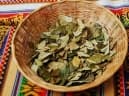
Erythroxylum coca
Erythroxylum coca
Safety & Hazards
None known
Cultivation Details
A plant of moderate to higher elevations in the tropics. It grows best in areas where annual daytime temperatures are within the range 17 - 23°c, but can tolerate 14 - 27°c[1]. Mature plants can be killed by temperatures of -5°c or lower, but young growth will be severely damaged at -1°c[1]. It prefers a mean annual rainfall in the range 1,000 - 2,100mm, but tolerates 700 - 4,000mm[1]. Widely cultivated in the Andean region of the tropics, where it locally also occurs wild, the plant is not easy to cultivate elsewhere, and it is little known in other parts of the world. In South-East Asia, it is only grown in botanical gardens, not as a crop[2]. The form Erythroxylum coca ipadu is only found as a cultivated plant in Amazonian lowland rain forest areas[2]. Grows best in a sunny position[1]. Succeeds in most fertile, well-drained soils[1]. Prefers a pH in the range 5.5 - 6.5, tolerating 4.3 - 8[1]. Plants take 1 - 3 years from seed to the first harvest, and then have an economical life of around 20 years[1]. Annual yields are up to 2 tonnes/ha of dried leaves[1].
Propagation
Seed - Cite as: Tropical Plants Database, Ken Fern. tropical.theferns.info. 2026-02-20. <tropical.theferns.info/viewtropical.php?id=Erythroxylum+coca>
Pollinators
Data unavailable
References
- [1]Ecocrop — http://ecocrop.fao.org/ecocrop/srv/en/home ↩︎Basic information on a wide range of useful plants, plus details of environmental needs where available.
- [2]Plant Resources of Southeast Asia — http://proseanet.org/ ↩︎Lots of information on the uses of the plants of SE Asia.
- [3]Mansfeld's Database of Agricultural and Horticultural Plants — http://mansfeld.ipk-gatersleben.de/pls/htmldb_pgrc/f?p=185:3:4292127278597336 ↩︎Terse details of a huge range of useful plants.
- [4]Dictionary of Economic Plants. — Uphof. J. C. Th. · Weinheim · 1959 · ISBN - ↩︎An excellent and very comprehensive guide but it only gives very short descriptions of the uses without any details of how to utilize the plants. Not for the casual reader.
- [5]Medicinal Plants of the Guianas — DeFilipps, R. A.; Maina, S. L.; & Crepin, J. · Smithsonian Museum · http://botany.si.edu/bdg/medicinal/index.html ↩︎A down-loadable PDF document of a book in pre-publication awaiting illustration. An excellent, if rather terse, guide to the traditional medicinal uses of the plants of the region