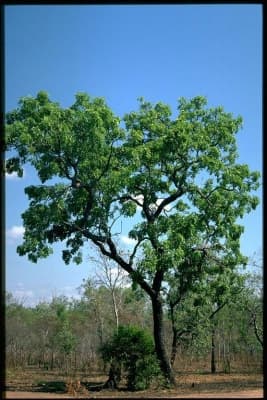
Erythrophleum chlorostachys
Erythrophleum chlorostachys
Safety & Hazards
All parts of the tree are highly poisonous[1]. The leaves (particularly the leaves of sucker shoots) have caused losses in cattle, horses, sheep, donkey, goats and camels[2]. People working with the wood in sawmills should be careful as it is suspected of causing dermatitis[2]. Splinters of the wood are reputed to cause complications[2]. Shade trees growing near houses where the rain water is collected in tanks should be viewed with suspicion. There have been reported cases of poisoning caused by the leaves being washed into the tank and or roof gutters[2].
Cultivation Details
A plant of the drier to moist tropics, where it is found at elevations from 100 - 1,100 metres. It grows best in areas where annual daytime temperatures are within the range 22 - 28°c, but can tolerate 13 - 43°c[1]. It prefers a mean annual rainfall in the range 1,000 - 1,400mm, but tolerates 300 - 1,700mm[1]. The annual rainfall figures given may not fully reflect the water requirement of the tree, since it often grow on sites where it can obtain additional water from other sources[1]. Grows best in a sunny position, tolerating some shade[1]. Succeeds in most well-drained soils of low to moderate fertility[1]. Prefers a pH in the range 5.5 - 6.5, tolerating 4.5 - 7.5[1]. This species has a symbiotic relationship with certain soil bacteria, these bacteria form nodules on the roots and fix atmospheric nitrogen. Some of this nitrogen is utilized by the growing plant but some can also be used by other plants growing nearby[3].
Propagation
Seed - Cite as: Tropical Plants Database, Ken Fern. tropical.theferns.info. 2026-02-20. <tropical.theferns.info/viewtropical.php?id=Erythrophleum+chlorostachys>
Pollinators
Data unavailable
References
- [1]Ecocrop — http://ecocrop.fao.org/ecocrop/srv/en/home ↩︎Basic information on a wide range of useful plants, plus details of environmental needs where available.
- [2]Australian Tropical Rainforest Plants — http://www.anbg.gov.au/cpbr/cd-keys/rfk/index.html ↩︎An online resource giving botanical information, and a little bit about plant usage, for over 2,700 species of plants found in the Australian rainforest.
- [3]The New RHS Dictionary of Gardening. 1992. — Huxley. A. · MacMillan Press · 1992 · ISBN 0-333-47494-5 ↩︎Excellent and very comprehensive, though it contains a number of silly mistakes. Readable yet also very detailed.