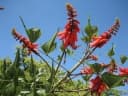
Erythrina humeana
Erythrina humeana
Safety & Hazards
All Erythrina species contain greater or lesser amounts of toxic alkaloids - these can be found in all parts of the plant but are usually most concentrated in the seeds. Concentrations vary from species to species, in some it is low enough that the plant is safely used as a food. In many, the alkaloids are utilized for their medicinal effects. We have no specific information on the concentration of the alkaloids in this species, but care should be exercised in any use of the plant that involves ingestion. These alkaloids have a curare-like action (obtained from Strychnos species) and can cause paralysis and even death by respiratory failure[1, PFAF].
Cultivation Details
Erythrina humeana is native to the subtropical and tropical regions of southern east Africa, growing in sub-arid climates. Plants experience at least moderate frosts in their native range, but dislike high levels of rainfall[2]. The plant can resprout from its large, tuberous rootstock if cut back by frosts, and so can be grown in mild winter climates in drier parts of the warm temperate zone. The stem bases should be thickly mulched with organic matter such as leaf litter or sawdust and covered with bracken[2]. The top growth will be killed by the frost but new growth should be produced from the rootstock in spring and this will flower in late summer[2]. Requires a moderately fertile well-drained soil in a very sunny position[2]. Succeeds in dry soils[3]. Best if planted in a sunny position and given of wall behind it[2]. Plants are very drought tolerant[4]. Plants are not very hardy outdoors in Britain though they experience at least moderate frosts in their native range and would be worthwhile trying outdoors in the very mildest areas of this country[2]. Plants take 3 - 4 years to flower from seed[2]. This species has a symbiotic relationship with certain soil bacteria, these bacteria form nodules on the roots and fix atmospheric nitrogen. Some of this nitrogen is utilized by the growing plant but some can also be used by other plants growing nearby[2].
Propagation
Seed - pre-soak for 12 hours in warm water and sow spring in a greenhouse. When they are large enough to handle, prick the seedlings out into individual pots and grow them on in the greenhouse for at least their first winter. Plant them out into their permanent positions in late spring or early summer, after the last expected frosts. Cuttings of half-ripe wood, mid summer in a frame[2]. Overwinter in a greenhouse and plant out in late spring or early summer. Heeled cuttings of young growth in the spring in a frame[2]. Overwinter in a greenhouse and plant out in late spring or early summer. Cite as: Temperate Plants Database, Ken Fern. temperate.theferns.info. 2026-02-21. <temperate.theferns.info/plant/Erythrina+humeana>
Pollinators
Birds, Insects
References
- [1]The Leguminosae; A Source Book of Characteristics, Uses and Nodulation — Allen O.N.; Allen E.K. · University of Wisconsin · 1981 · ISBN 0-333-32221-5 ↩︎An amazing and comprehensive work, giving a brief guide to the many genera of the family Fabaceae and also the principle uses of the genus.
- [2]The New RHS Dictionary of Gardening. 1992. — Huxley. A. · MacMillan Press · 1992 · ISBN 0-333-47494-5 ↩︎Excellent and very comprehensive, though it contains a number of silly mistakes. Readable yet also very detailed.
- [3]Bihrmann's Caudiciforms — http://www.bihrmann.com/caudiciforms/ ↩︎An internet site giving information on caudiciform plants (plants with swollen stem bases such as the Baobab tree, cycads and many succulents). Excellent photos, usually of cultivated plants in pots.
- [4]PlantZAfrica.com — http://www.plantzafrica.com ↩︎An excellent site giving detailed descriptions and uses of many S. African plants.
- [5]African Flowering Plants Database — Conservatoire et Jardin Botaniques. · http://www.ville-ge.ch/musinfo/bd/cjb/africa/recherche.php ↩︎Contains information on over 150,000 plant names (including synonyms) giving a description and habitat, plus a distribution map.
- [6]Flora Zambesiaca — http://apps.kew.org/efloras/fz/intro.html ↩︎An excellent online flora of plants from the Zambezi River basin. It lists a number of the plant uses as well as the habitats and botanical descriptions of the plants.
- [PFAF]Plants for a Future — pfaf.org ↩︎