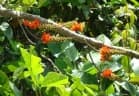
Erythrina edulis
Erythrina edulis
Safety & Hazards
Research indicates that the uncooked seeds can be toxic if consumed over a long period[1]. All Erythrina species contain greater or lesser amounts of toxic alkaloids - these can be found in all parts of the plant but are usually most concentrated in the seeds. Concentrations vary from species to species, in some it is low enough that the plant is safely used as a food. In many, the alkaloids are utilized for their medicinal effects. We have no specific information on the concentration of the alkaloids in this species, but care should be exercised in any use of the plant that involves ingestion. These alkaloids have a curare-like action (obtained from Strychnos species) and can cause paralysis and even death by respiratory failure[2, PFAF].
Cultivation Details
A plant of higher elevation in the dry to moist tropics. It is found at a wide range of elevations from 900 - 3,200 metres, and grows in areas where the annual temperatures range between 5 - 25°c and the rainfall is 450 - 1,800mm[1]. Plants do not tolerate frequent frosts[1]. Grows well in loose-textured sandy loams and in heavy clay soils, but does not like strongly acidic soils where the pH is below 4.5[1]. A pioneer species, it grows best in full sunlight, but trees can tolerate some shade in the early stages of growth[1]. It does not tolerate long periods of drought, especially during the early stages of establishment[1]. The species is cultivated at quite high altitudes, between 1,800 - 2,200 metres, in the Central Andes, and in Colombia between 1,000 - 2,700 metres[3]. The tree has a normal life span of 30 - 40 years[1]. Seedlings grow rapidly (2.5 metres tall in the 1st year) and begin producing fruit in approximately 24 - 27 months[1]. Cuttings begin producing fruit about 18 months after planting[1]. In Colombia, live fence posts are established from stakes at 2 metre intervals and allowed to grow for 30 months before pruning or attaching barbed wire[1]. Left unpruned, the posts can provide up to 85 tons of fruit[1]. Seeds mature about three months after the plant flowers[1]. All species in this genus are believed to be self-compatible. Their flowers are adapted to pollination by birds, though various insects can also cause fertilization. The various species of Erythrina can all, as far as is known, be intercrossed to produce fertile hybrids. Those species most closely related to each other cross fairly readily, but even species that are quite distant can hybridize[4, 5]. This species has a symbiotic relationship with certain soil bacteria, these bacteria form nodules on the roots and fix atmospheric nitrogen. Some of this nitrogen is utilized by the growing plant but some can also be used by other plants growing nearby[6].
Propagation
Plants are easily propagated from seed or cuttings, but seedlings tend to root deeper and live longer than cuttings[1]. Seed - larger seeds tend to produce more vigorous seedlings. Seeds should be planted in 1-kg polyethylene bags with the convex side facing upwards and slightly exposed. Germination begins in 5 - 10 days[1]. Seedlings should be shaded in the nursery and shade partially reduced in the last two weeks before planting out[1]. At 60 days, seedlings may be planted out in holes 30 cm deep[1]. The plant can also be direct seeded[1]. Seed should be removed from pods immediately and stored in paper bags in a cool, dark place[1]. Seeds lose viability quickly and should be planted within 8 days of harvesting[1]. Viability can be extended up to 20 days by dipping seeds in molten paraffin so that a thin layer of paraffin coats the entire seed[1]. Cuttings of 4-6 cm diameter, and usually 1 m in length, should be planted to a depth of 30-50 cm within 3 days of cutting[1]. Cuts should be made with well-sharpened tools to avoid damage that can lead to rotting; the top cut should be at a 45° angle[1]. Sealing the cuts with paraffin, plastic, mud or other material can increase survival rates[1]. Cite as: Tropical Plants Database, Ken Fern. tropical.theferns.info. 2026-02-20. <tropical.theferns.info/viewtropical.php?id=Erythrina+edulis>
Pollinators
Bees, Wasps, Birds
References
- [1]World Agroforesty Centre — http://www.worldagroforestry.org/ ↩︎An excellent online database of a huge range of trees giving very good information on each plant - its uses, ecology, identity, propagation, pests etc.
- [2]The Leguminosae; A Source Book of Characteristics, Uses and Nodulation — Allen O.N.; Allen E.K. · University of Wisconsin · 1981 · ISBN 0-333-32221-5 ↩︎An amazing and comprehensive work, giving a brief guide to the many genera of the family Fabaceae and also the principle uses of the genus.
- [3]Mansfeld's Database of Agricultural and Horticultural Plants — http://mansfeld.ipk-gatersleben.de/pls/htmldb_pgrc/f?p=185:3:4292127278597336 ↩︎Terse details of a huge range of useful plants.
- [4]Plant Resources of Southeast Asia — http://proseanet.org/ ↩︎Lots of information on the uses of the plants of SE Asia.
- [5]Annals of the Missouri Botanical Garden. Vol 75 — Missouri Botanical Garden: Boston. · 1988 · http://www.biodiversitylibrary.org ↩︎Contains, amongst other things, an article on the flora of Tanzania, a treatment of the genus Xyris and one for the Panamanian Boraginaceae. It can be downloaded from the internet.
- [6]Nodulation Plants in GRIN Taxonomy — United States Department of Agriculture · http://www.ars-grin.gov/~sbmljw/cgi-bin/taxnodul.pl?language=en ↩︎An online database listing plants that have either positive or negative reports on root and stem nodulation with nitrogen-fixing bacteria.
- [7]Forest, Farm, and Community Tree Network — http://www.winrock.org/fnrm/factnet/factnet.htm ↩︎A series of in-depth factsheets on a wide range of plants, especially leguminous trees.
- [8]Cornucopia II — Facciola. S. · Kampong Publications, California. · 1998 · ISBN 0-9628087-2-5 ↩︎The second edition of an excellent guide to the edible uses of plants, though it does not give any details of cultivation etc.
- [PFAF]Plants for a Future — pfaf.org ↩︎