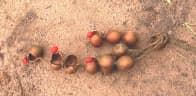
Erythrina abyssinica
Erythrina abyssinica
Safety & Hazards
The seeds contain a curare-like poison[1]. If injected into the bloodstream, it acts as an anaesthetic that may cause paralysis and even death by respiratory failure[2]. Although no specific mention has been seen for this species, the bark and stems of plants in this genus usually contain alkaloids that are toxic in all but small amounts[PFAF].
Cultivation Details
A tree of low to moderate elevations in tropical areas, where it can be found at elevations up to 2,300 metres[1]. It grows naturally in areas where the mean annual rainfall is in the range 800 - 1,500mm, though it has also been shown to succeed with rainfall as low as500mm or as high as 2,500mm[1, 3]. Its optimal temperature range is in the range 15 - 25°c, tolerating 10 - 30[1, 3]. Plants do not tolerate frost[1]. The plant is moderately light-demanding[4]. It is found in the wild on loamy to clayey soils, preferring deep well-drained soils on plateaus and slopes, with a pH of 3.5 - 5.5[1]. Prefers a pH in the range 4 - 5.5, tolerating 3.5 - 6.5[3]. Seedlings develop a deep root system before stem growth starts[1]. Trees are fire resistant, and even seedlings resprout after fires, due to their deep root system[1]. Trees grow moderately fast, but growth rates vary widely depending on soil conditions[1]. Trees can be managed by pollarding and coppicing[1]. Older trees coppice readily[4]. Planting large stakes of 2.5 metres long and 8 - 10 cm in diameter is sometimes practised in order to produce large trees quickly[1]. These stakes can produce a canopy of 3 - 4 m in diameter within 6 months[1]. All species in this genus are believed to be self-compatible. Their flowers are adapted to pollination by birds, though various insects can also cause fertilization. The various species of Erythrina can all, as far as is known, be intercrossed to produce fertile hybrids. Those species most closely related to each other cross fairly readily, but even species that are quite distant can hybridize[5, 6]. The flowers provide nectar and pollen for bees at the end of the dry season, strengthening bee colonies in this difficult period[1]. This species has a symbiotic relationship with certain soil bacteria, these bacteria form nodules on the roots and fix atmospheric nitrogen. Some of this nitrogen is utilized by the growing plant but some can also be used by other plants growing nearby[7].
Propagation
Seed - the germination rate is generally low, around 10 - 30%[1]. Pre-treatment with hot water or concentrated sulphuric acid may increase the germination rate up to 90%[1]. Scarification of seeds is also beneficial for germination; this can be done by rubbing with sandpaper or nicking with a knife, after which the seeds should be immersed in water for some hours until they begin to swell[1]. To obtain optimal growth, seeds are inoculated with appropriate Rhizobium bacteria immediately before sowing[1]. Seeds can be sown in seed beds of sterile sand or in polythene bags with a mixture of soil, sand and compost (2:1:1). They should be sown with the hilum facing downward and covered with a thin layer of potting medium[1]. Seedlings can be transplanted when 20 - 30 cm tall[1]. Direct sowing in the field is also possible[1]. Seeds should be collected from ripe pods still on the tree; they are widely available. They are sun dried for one day before storage. Seeds can be stored for long periods if they are kept in a cool and dry place and kept free from insects, e.g. By adding ash[1]. Cuttings are often successful when these are planted in the rainy season[1]. They are stripped of leaves and planted directly[1]. Truncheons up to 2.5 metres long are commonly used to make living fences and produce shade trees quickly[1]. Air-layering is possible[1]. Cite as: Tropical Plants Database, Ken Fern. tropical.theferns.info. 2026-02-20. <tropical.theferns.info/viewtropical.php?id=Erythrina+abyssinica>
Pollinators
Birds, Bees
References
- [1]Protabase - Plant Resources of Tropical Africa. — http://www.prota.org ↩︎An excellent on-line database with detailed information on over 3,200 species of useful plants of Africa.
- [2]World Agroforesty Centre — http://www.worldagroforestry.org/ ↩︎An excellent online database of a huge range of trees giving very good information on each plant - its uses, ecology, identity, propagation, pests etc.
- [3]Ecocrop — http://ecocrop.fao.org/ecocrop/srv/en/home ↩︎Basic information on a wide range of useful plants, plus details of environmental needs where available.
- [4]Indigenous multipurpose trees of Tanzania. — Hines. D.A. & Eckman. K. · 1993 · ISBN 0-9697075-0-9 ↩︎A simple handbook with information on over 50 species of trees found in Tanzania giving details of environmental requirements, cultivation needs, uses etc. It can be downloaded from the Internet.
- [5]Plant Resources of Southeast Asia — http://proseanet.org/ ↩︎Lots of information on the uses of the plants of SE Asia.
- [6]Annals of the Missouri Botanical Garden. Vol 75 — Missouri Botanical Garden: Boston. · 1988 · http://www.biodiversitylibrary.org ↩︎Contains, amongst other things, an article on the flora of Tanzania, a treatment of the genus Xyris and one for the Panamanian Boraginaceae. It can be downloaded from the internet.
- [7]Nodulation Plants in GRIN Taxonomy — United States Department of Agriculture · http://www.ars-grin.gov/~sbmljw/cgi-bin/taxnodul.pl?language=en ↩︎An online database listing plants that have either positive or negative reports on root and stem nodulation with nitrogen-fixing bacteria.
- [8]African Flowering Plants Database — Conservatoire et Jardin Botaniques. · http://www.ville-ge.ch/musinfo/bd/cjb/africa/recherche.php ↩︎Contains information on over 150,000 plant names (including synonyms) giving a description and habitat, plus a distribution map.
- [9]Chemical constituents of root and stem bark of Erythrina brucei — Getahun Tadesse Gurmessa et al · 2018 · https://doi.org/10.1016/j.phytol.2018.03.006 ↩︎
- [PFAF]Plants for a Future — pfaf.org ↩︎