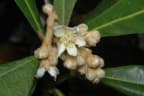
Eriobotrya japonica
Eriobotrya japonica
Safety & Hazards
The seed is slightly poisonous. This report probably refers to the hydrogen cyanide that is found in many plants of this family, the seed should only be used in small amounts if it is bitter[PFAF]. In small quantities, hydrogen cyanide has been shown to stimulate respiration and improve digestion, it is also claimed to be of benefit in the treatment of cancer. In excess, however, it can cause respiratory failure and even death.
Cultivation Details
Eriobotrya japonica is a plant of the subtropics and temperate zones with very mild winters, it can be cultivated in the tropics at elevations above 600 metres, growing best at 1,000 - 2,300 metres[1]. The best fruit quality is however often obtained in regions close to the sea[1]. It grows best in areas where annual daytime temperatures are within the range 21 - 27°c, but can tolerate 9 - 36°c[1]. The dormant plant can survive temperatures down to about -12°c, but the flowers and young leaves can be killed at -1°c[1]. It prefers a mean annual rainfall in the range 600 - 1,600mm, but tolerates 400 - 4,000mm[1]. Prefers a fertile well-drained soil in full sun or light shade[2]. Succeeds in any well-drained soil but dislikes too much lime[3]. Prefers to be near the coast, tolerating maritime exposure but disliking cold winds[2]. Tolerates dry soils[2]. Prefers a pH in the range 5.5 - 6.5, tolerating 4.5 - 8[1]. A productive and regular bearer, barring crop failure resulting from severe frosts at flowering time, the tree rarely fails to produce well every year. The tendency is to overbear, with the result that the fruits are apt to be undersized. It has been profitable to thin the crop, since the increased size of the fruits remaining on the tree more than compensates for the fruits removed[303. In India the average fruit yield per tree is 16 - 20 kilos per year, but yields can be up to about 100 kilos per tree. Average yield in Japan is about 8 tonnes/ha and the highest yield recorded is 25 tonnes/ha in Israel[1]. Often cultivated for its edible fruit in warm temperate regions, there are more than 800 cultivars in Japan[2]. 'Advance' is a dwarf tree with very juicy fruits[2].
Propagation
Seed - best sown as soon as it is ripe in a cold fame in the spring[2]. Pre-soak stored seed for 24 hours and sow late winter in a warm greenhouse[4, 5]. Germination usually takes place within 1 - 4 months at 20°c. When they are large enough to handle, prick the seedlings out into individual pots and grow them on in the greenhouse for at least their first winter. Plant them out into their permanent positions in late spring or early summer, after the last expected frosts. Cuttings of half-ripe wood with a heel, mid summer in a frame[2]. Cuttings of softwood, spring in a frame[4]. Air layering[2]. Cite as: Temperate Plants Database, Ken Fern. temperate.theferns.info. 2026-02-21. <temperate.theferns.info/plant/Eriobotrya+japonica>
Pollinators
Bees, Flies
References
- [1]Ecocrop — http://ecocrop.fao.org/ecocrop/srv/en/home ↩︎Basic information on a wide range of useful plants, plus details of environmental needs where available.
- [2]The New RHS Dictionary of Gardening. 1992. — Huxley. A. · MacMillan Press · 1992 · ISBN 0-333-47494-5 ↩︎Excellent and very comprehensive, though it contains a number of silly mistakes. Readable yet also very detailed.
- [3]Growing Unusual Fruit. — Simmons. A. E. · David & Charles; Newton Abbot. · 1972 · ISBN 0-7153-5531-7 ↩︎A very readable book with information on about 100 species that can be grown in Britain (some in greenhouses) and details on how to grow and use them.
- [4]Propagation of Trees, Shrubs and Conifers. — Sheat. W. G. · MacMillan and Co · 1948 · ISBN - ↩︎A bit dated but a good book on propagation techniques with specific details for a wide range of plants.
- [5]The Reference Manual of Woody Plant Propagation. — Dirr. M. A. and Heuser. M. W. · Athens Ga. Varsity Press · 1987 · ISBN 0942375009 ↩︎A very detailed book on propagating trees. Not for the casual reader.
- [6]World Agroforesty Centre — http://www.worldagroforestry.org/ ↩︎An excellent online database of a huge range of trees giving very good information on each plant - its uses, ecology, identity, propagation, pests etc.
- [7]Plantae Wilsonae. Vol 1 - 3 — Wilson. E. H. · University Press; Cambridge. · 1911 - 1917 · http://www.biodiversitylibrary.org ↩︎Details of the palnts collected by the plant collector E. H. Wilson on his travels in China. Gives some habitats. Not for the casual reader. It can be downloaded from the internet.
- [8]Dictionary of Economic Plants. — Uphof. J. C. Th. · Weinheim · 1959 · ISBN - ↩︎An excellent and very comprehensive guide but it only gives very short descriptions of the uses without any details of how to utilize the plants. Not for the casual reader.
- [9]Cornucopia - A Source Book of Edible Plants. — Facciola. S. · Kampong Publications · 1990 · ISBN 0-9628087-0-9 ↩︎Excellent. Contains a very wide range of conventional and unconventional food plants (including tropical) and where they can be obtained (mainly N. American nurseries but also research institutes and a lot of other nurseries from around the world.
- [10]Medicinal Plants of China — Duke. J. A. and Ayensu. E. S. · Reference Publications, Inc. · 1985 · ISBN 0-917256-20-4 ↩︎Details of over 1,200 medicinal plants of China and brief details of their uses. Often includes an analysis, or at least a list of constituents. Heavy going if you are not into the subject.
- [11]Plants Consumed by Man. — Brouk. B. · Academic Press · 1975 · ISBN 0-12-136450-x ↩︎Readable but not very comprehensive.
- [12]Tanaka's Cyclopedia of Edible Plants of the World. — Tanaka. T. & Nakao S. · Keigaku Publishing; Tokyo · 1976 · ISBN - ↩︎The most comprehensive list of edible plants I've come across. Only the briefest entry for each species, though, and some of the entries are more than a little dubious. Not for the casual reader.
- [13]Plants for Human Consumption. — Kunkel. G. · Koeltz Scientific Books · 1984 · ISBN 3874292169 ↩︎An excellent book for the dedicated. A comprehensive listing of Latin names with a brief list of edible parts.
- [14]Encyclopaedia of Herbs and their Uses. — Bown. D. · Dorling Kindersley, London. · 1995 · ISBN 0-7513-020-31 ↩︎A very well presented and informative book on herbs from around the globe. Plenty in it for both the casual reader and the serious student. Just one main quibble is the silly way of having two separate entries for each plant.
- [15]Encyclopaedia of Medicinal Plants. — Chiej. R. · MacDonald · 1984 · ISBN 0-356-10541-5 ↩︎Covers plants growing in Europe. Also gives other interesting information on the plants. Good photographs.
- [16]Oriental Herbs and Vegetables, Vol 39 No. 2. — Brooklyn Botanic Garden · Brooklyn Botanic Garden · 1986 · ISBN - ↩︎A small booklet packed with information.
- [17]A Barefoot Doctors Manual. — ? · Running Press; Philadelphica. · 1977 · ISBN 0-914294-92-X ↩︎A very readable herbal from China, combining some modern methods with traditional chinese methods.
- [18]Handbook of Chinese Herbs and Formulas. — Yeung. Him-Che. · Institute of Chinese Medicine, Los Angeles · 1985 · ISBN - ↩︎An excellent Chinese herbal giving information on over 500 species. Rather technical and probably best suited to the more accomplished user of herbs.
- [19]Medicinal Plants in the Republic of Korea — World Health Organisation, Manila · 1998 · ISBN 92 9061 120 0 ↩︎An excellent book with terse details about the medicinal uses of the plants with references to scientific trials. All plants are described, illustrated and brief details of habitats given.
- [20]Glossary of Indian Medicinal Plants (Including the Supplement). — Chopra. R. N., Nayar. S. L. and Chopra. I. C. · Council of Scientific and Industrial Research, New Delhi. · 1986 · ISBN - ↩︎Very terse details of medicinal uses of plants with a wide range of references and details of research into the plants chemistry. Not for the casual reader.
- [21]Scented Flora of the World. — Genders. R. · Robert Hale. London. · 1994 · ISBN 0-7090-5440-8 ↩︎An excellent, comprehensive book on scented plants giving a few other plant uses and brief cultivation details. There are no illustrations.
- [22]A Manual of Indian Timbers. — Gamble. J. S. · Bishen Singh Mahendra Pal Singh · 1972 · ISBN - ↩︎First written in the 19th century, but still a classic, giving a lot of information on the uses and habitats of Indian trees. Not for the casual reader.
- [PFAF]Plants for a Future — pfaf.org ↩︎