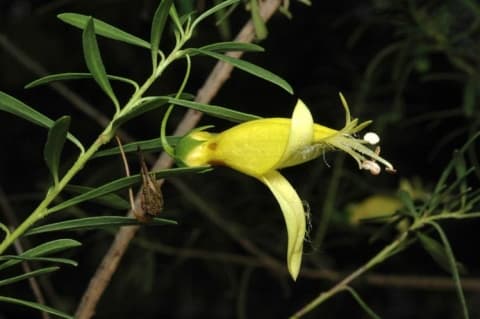
Eremophila maculata
Eremophila maculata
Safety & Hazards
None known
Cultivation Details
Eremophila maculata is a plant of drier regions in the tropical, subtropical and warm temperate zones of Australia, where it is said to be able to withstand occasional short-lived temperatures down to around -7°c[1].
Propagation
Seed - sow spring in a greenhouse. When they are large enough to handle, prick the seedlings out into individual pots and grow them on in the greenhouse for at least their first winter. Plant them out into their permanent positions in late spring or early summer, after the last expected frosts. Consider giving the plants some protection from the cold for their first few winters outdoors. Cuttings of half-ripe wood, 5 - 10cm with a heel, July/August in a frame. Pot up in the autumn. Good percentage[2]. Cite as: Temperate Plants Database, Ken Fern. temperate.theferns.info. 2026-02-21. <temperate.theferns.info/plant/Eremophila+maculata>
Pollinators
Data unavailable
References
- [1]Australian Native Plants. — Wrigley. J. W. and Fagg. M. · Collins. (Australia) · 1988 · ISBN 0-7322-0021-0 ↩︎A lovely book, written in order to encourage Australian gardeners to grow their native plants. A little bit of information for the plant project.
- [2]Propagation of Trees, Shrubs and Conifers. — Sheat. W. G. · MacMillan and Co · 1948 · ISBN - ↩︎A bit dated but a good book on propagation techniques with specific details for a wide range of plants.
- [3]Australian Medicinal Plants. — Lassak. E. V. and McCarthy. T. · New Holland Publishers · 2001 · ISBN 1876334703 ↩︎A very good and readable guide to the subject.
- [4]Flora of New South Wales — http://plantnet.rbgsyd.nsw.gov.au/floraonline.htm ↩︎An on-line resource giving a brief botanical description of all the native plants of New South Wales, their habitat and range, together with diagrams and photographs of the plants.
- [5]An Ethnopharmacological Study of Medicinal Plants of the Kamilaroi and Muruwari Aboriginal Communities in Northern N — Qian Liu · 2006 ↩︎In particular it looks at Ethnopharacological information on the genera Eremurus and Exocarpus. It can be downloaded from the Internet.