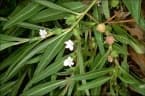
Eremophila debilis
Eremophila debilis
Safety & Hazards
The fruit of this plant probably contains a liver toxin[1].
Cultivation Details
Eremophila debilis is found mainly in warm temperate to subtropical areas, but also extending into the tropics. It can tolerate occasional mild frosts, but appreciates the added protection given by growing it under trees[2]. Succeeds in full sun and in moderate shade[2]. Easily grown in most soils[3]. Found in the wild in clay soils[2]. Succeeds in dry soils[4].
Propagation
Seed - sow spring in a greenhouse. When they are large enough to handle, prick the seedlings out into individual pots and grow them on in the greenhouse for at least their first winter. Plant them out into their permanent positions in late spring or early summer, after the last expected frosts. Consider giving the plants some protection from the cold for their first few winters outdoors. Cuttings of half-ripe wood, 5 - 10cm with a heel, mid summer in a frame. They normally root within 3 - 4 weeks[2]. Pot up in the autumn. Good percentage[5]. Cite as: Temperate Plants Database, Ken Fern. temperate.theferns.info. 2026-02-21. <temperate.theferns.info/plant/Eremophila+debilis>
Pollinators
Data unavailable
References
- [1]Native Edible Plants of New Zealand. — Crowe. A. · Hodder and Stoughton · 1990 · ISBN 0-340-508302 ↩︎A very well written and illustrated book based on the authors own experiments with living on a native diet.
- [2]Growing Native Plants — Australian National Botanic Gardens · http://www.anbg.gov.au/gnp/ ↩︎A series of articles giving details of cultivation and matters of general interest (including a few plant uses) on over 250 Australian plants.
- [3]A Field Guide to Australian Trees. — Holliday. I. and Hill. R. · Frederick Muller Ltd. · 1974 · ISBN 0-85179-627-3 ↩︎A well illustrated and very readable book, but it does not contain much information for the plant project.
- [4]The New RHS Dictionary of Gardening. 1992. — Huxley. A. · MacMillan Press · 1992 · ISBN 0-333-47494-5 ↩︎Excellent and very comprehensive, though it contains a number of silly mistakes. Readable yet also very detailed.
- [5]Propagation of Trees, Shrubs and Conifers. — Sheat. W. G. · MacMillan and Co · 1948 · ISBN - ↩︎A bit dated but a good book on propagation techniques with specific details for a wide range of plants.
- [6]Australian Medicinal Plants. — Lassak. E. V. and McCarthy. T. · New Holland Publishers · 2001 · ISBN 1876334703 ↩︎A very good and readable guide to the subject.
- [7]Flora of the Sydney Region — Carolin. R. & Tindale. M. · Reed. Australia. · 1993 · ISBN 0730104001 ↩︎Concise flora with little beyond an extensive key, species descriptions, very brief habitat description.
- [8]Flora of New Zealand. — Allan. H. H. · Government Printer, Wellington. · 1961 · http://floraseries.landcareresearch.co.nz/pages/Book.aspx?fileName=Flora%201.xml · ISBN - ↩︎The standard work, in 5 volumes though only the first two are of interest to the plant project. Very good on habitats. There is also an on-line version.
- [9]Dictionary of Economic Plants. — Uphof. J. C. Th. · Weinheim · 1959 · ISBN - ↩︎An excellent and very comprehensive guide but it only gives very short descriptions of the uses without any details of how to utilize the plants. Not for the casual reader.
- [10]A Dictionary of Plants Used by Man. — Usher. G. · Constable · 1974 · ISBN 0094579202 ↩︎Forget the sexist title, this is one of the best books on the subject. Lists a very extensive range of useful plants from around the world with very brief details of the uses. Not for the casual reader.
- [11]Wild Food in Australia. — Cribb. A. B. and J. W. · Fontana · 1976 · ISBN 0-00-634436-4 ↩︎A very good pocket guide.
- [12]Wild Food Plants of Australia. — Low. T. · Angus and Robertson. · 1989 · ISBN 0-207-14383-8 ↩︎Well presented, clear information and good photographs. An interesting read for the casual reader as well as the enthusiast