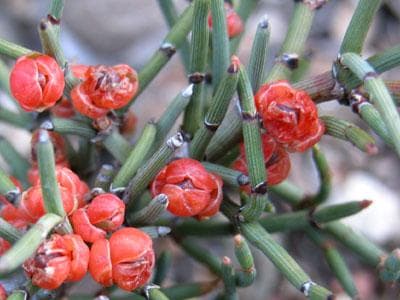
Ephedra americana
Ephedra americana
Safety & Hazards
Many species in this genus contain phenylethylamine alkaloids (e.g. ephedrine, pseudoephedrine). These compounds have stimulant properties and are effective medications in the treatment of a number of conditions. However, they do also have potential side effects and are contraindicated in a number of conditions including anxiety, anorexia, bulimia, diabetes, glaucoma, hypertension, thyrotoxicosis[1].
Cultivation Details
Most Ephedra species are native to warm, dry, inhospitable regions, frequently found on stony slopes and gravel terraces, often on limestone[2]. Ephedra americana is found mainly in the subtropical regions of the Andes and is generally not very frost tolerant.. Requires a porous, freely-draining soil in a sunny position[2]. Grows well in dry soils and are very drought tolerant once established[2]. A dioecious plant, both male and female forms need to be grown if fruit and seed are required. Plants require a good summer in order to fully ripen their wood - this will encourage good flowering and fruiting the following summer.
Propagation
Seed - best sown as soon as it is ripe in the autumn in a greenhouse[2]. It can also be sown in spring in a greenhouse in a sandy compost[PFAF]. Prick out the seedlings into individual pots as soon as they are large enough to handle and grow them on for at least their first winter in a greenhouse. Plant out in the spring or early summer after the last expected frosts and give some protection in their first winter[PFAF]. Division in spring or autumn[3]. Layering. Cite as: Temperate Plants Database, Ken Fern. temperate.theferns.info. 2026-02-21. <temperate.theferns.info/plant/Ephedra+americana>
Pollinators
Data unavailable
References
- [1]Ephedra foeminea Forssk. — 2023 · https://florapal.org/plant/ephedra-foeminea/ ↩︎
- [2]The New RHS Dictionary of Gardening. 1992. — Huxley. A. · MacMillan Press · 1992 · ISBN 0-333-47494-5 ↩︎Excellent and very comprehensive, though it contains a number of silly mistakes. Readable yet also very detailed.
- [3]Encyclopaedia of Herbs and their Uses. — Bown. D. · Dorling Kindersley, London. · 1995 · ISBN 0-7513-020-31 ↩︎A very well presented and informative book on herbs from around the globe. Plenty in it for both the casual reader and the serious student. Just one main quibble is the silly way of having two separate entries for each plant.
- [4]Ethnobotany of the Andes — Bussmann R.W. & Paniagua-Zambrana N.Y. (Editors) · Springer Nature; Switzerland · 2020 · https://doi.org/10.1007/978-3-030-28933-1 · ISBN 978-3-030-28932-4 ↩︎
- [5]Dictionary of Economic Plants. — Uphof. J. C. Th. · Weinheim · 1959 · ISBN - ↩︎An excellent and very comprehensive guide but it only gives very short descriptions of the uses without any details of how to utilize the plants. Not for the casual reader.
- [6]IUCN Red List of Threatened Species — http://www.iucnredlist.org/ ↩︎A list of plants under threat and facing possible extinction, usually with brief details of the threats and information on habitat.
- [7]The Gymnosperm Database — http://www.conifers.org/index.htm ↩︎A vast amount of information on conifers and families of gymnosperms.
- [8]The Ethnobotany of Chinchero. — Franquemont C. Et al · Field Museum of Natural History. · 1990 · http://www.biodiversitylibrary.org · ISBN 0015-0746 ↩︎Brief details on the local uses of plants for an Andean community in southern Peru. It can be downloaded from the Internet.
- [9]The Encyclopedia of Medicinal Plants — Chevallier. A. · Dorling Kindersley. London · 1996 · ISBN 9-780751-303148 ↩︎An excellent guide to over 500 of the more well known medicinal herbs from around the world.
- [10]Revisión Taxonómica y Distribución Geográfica de Ephedra (Ephedraceae) en México — Villanueva-Almanza L. & Fonseca R.M. · 2011 ↩︎
- [PFAF]Plants for a Future — pfaf.org ↩︎