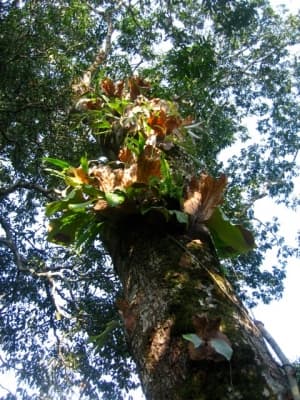
Entandrophragma utile
Entandrophragma utile
Safety & Hazards
None known
Cultivation Details
A tree of low to medium elevations in the moist tropics, where it can be found at elevations up to 1,400 metres. It is found mainly in regions with an annual rainfall in the range 1,400 - 2,500 mm, where there is a dry period of 2 - 4 months and a mean annual temperature of 24 - 26°c[1, 2]. Prefers well-drained localities on deep soils[1]. The species is characterized as a non-pioneer light demander and is generally noted to be more light-demanding and tolerant of dry conditions than other embers of the genus[1, 3]. Natural regeneration is often scarce in the forest, although it has also been reported as abundant[1]. Regeneration in large forest gaps is reportedly poor, but seedlings perform well in small forest gaps[1]. Saplings are more light-demanding than those of other members of the genus[1]. Young seedlings grow slowly; root development takes considerable time[1]. In Ghana, seedlings reached only up to 1 metre tall after 4 years, in silviculturally treated forest up to 1.5 metres[1]. Under nursery conditions, however, seedlings can reach 40 cm tall in 6 months and 75 cm in one year[1]. Fruit production starts when trees have reached bole diameters above 50 cm, and this has implications for forest management; minimum felling diameters should be well above 50 cm to allow natural regeneration[1]. A dioecious species, both male and female forms need to be grown if fruit and seed are required[2].
Propagation
Seed - pre-soaking the seeds in warm water is reported to improve germination[1]. Fresh seeds have a germination rate of about 75%, whilst that of 3-month-old seeds is still about 60%[1]. The seeds are liable to rotting and should hardly be covered with soil[1]. Germination starts 13 - 19 days after sowing[1]. Overhead shade promotes the survival of young seedlings, which are liable to mite and insect attacks in full sunlight[1]. The seedlings are physiologically well adapted to heavy shade and make efficient use of low light intensities - they usually die when growing under full light conditions[1]. Seedlings growing in 10 - 12% of full sunlight maintained high growth rates, and an irradiance of 25% of full sunlight is recorded to optimize growth of young seedlings[1]. When seedlings are grown in pots, it should be taken into account that they develop a long taproot; the roots should be cut back several times in the 1 - 2-year-long period that the seedlings are raised in the nursery[1]. Seeds can be stored for about 3 months in sealed containers in a cool place, but insect damage, to which they are very susceptible, should be avoided, e.g. by adding ash[1]. Stumps and striplings have been used for propagation, but the success rate of stumps was low[1]. Cite as: Tropical Plants Database, Ken Fern. tropical.theferns.info. 2026-02-20. <tropical.theferns.info/viewtropical.php?id=Entandrophragma+utile>
Pollinators
Data unavailable
References
- [1]Protabase - Plant Resources of Tropical Africa. — http://www.prota.org ↩︎An excellent on-line database with detailed information on over 3,200 species of useful plants of Africa.
- [2]World Agroforesty Centre — http://www.worldagroforestry.org/ ↩︎An excellent online database of a huge range of trees giving very good information on each plant - its uses, ecology, identity, propagation, pests etc.
- [3]IUCN Red List of Threatened Species — http://www.iucnredlist.org/ ↩︎A list of plants under threat and facing possible extinction, usually with brief details of the threats and information on habitat.
- [4]African Flowering Plants Database — Conservatoire et Jardin Botaniques. · http://www.ville-ge.ch/musinfo/bd/cjb/africa/recherche.php ↩︎Contains information on over 150,000 plant names (including synonyms) giving a description and habitat, plus a distribution map.
- [5]Tropix 7 — CIRAD · http://tropix.cirad.fr/en ↩︎An on-line guide to the timbers of 245 species of trees.