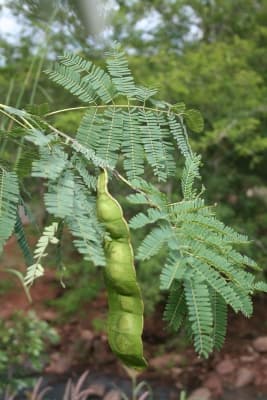
Entada abyssinica
Entada abyssinica
Safety & Hazards
The juice of the bark and cambium has been used as ordeal poison, placed under the eyelid[1].
Cultivation Details
A plant of the drier to moist tropics, where it is found at elevations up to 2,300 metres. It grows best in areas where annual daytime temperatures are within the range 20 - 28°c, but can tolerate 15 - 35°c[2]. It prefers a mean annual rainfall in the range 800 - 1,500mm, but tolerates 500 - 2,000mm[2]. The plant grows wild in areas where the mean annual rainfall is within the range 500 - 1,270mm[3]. Prefers a sunny position, tolerating light shade[3, 2]. Tolerates a variety of soils ranging from loam to clay loams and sometimes friable clay over laterite[3]. Prefers a sandy loam soil[2]. Prefers a pH in the range 5 - 7, tolerating 4.5 - 7.5[2]. A fast-growing plant when in a good soil[3]. The seedpods are very large, around 15 - 37cm long and 5cm wide[4]. Plants can be coppiced[3]. The plant is not resistant to bush fires[5]. This species has a symbiotic relationship with certain soil bacteria, these bacteria form nodules on the roots and fix atmospheric nitrogen. Some of this nitrogen is utilized by the growing plant but some can also be used by other plants growing nearby[1].
Propagation
Seed - it has a hard seedcoat and may benefit from scarification before sowing to speed up germination. This can usually be done by pouring a small amount of nearly boiling water on the seeds (being careful not to cook them!) and then soaking them for 12 - 24 hours in warm water. By this time they should have imbibed moisture and swollen - if they have not, then carefully make a nick in the seedcoat (being careful not to damage the embryo) and soak for a further 12 hours before sowing. Sow in individual containers in a sunny position[3]. A germination rate of 70 - 90% can be expected from treated seed[3]. Division of root suckers. Cite as: Tropical Plants Database, Ken Fern. tropical.theferns.info. 2026-02-20. <tropical.theferns.info/viewtropical.php?id=Entada+abyssinica>
Pollinators
Data unavailable
References
- [1]World Agroforesty Centre — http://www.worldagroforestry.org/ ↩︎An excellent online database of a huge range of trees giving very good information on each plant - its uses, ecology, identity, propagation, pests etc.
- [2]Ecocrop — http://ecocrop.fao.org/ecocrop/srv/en/home ↩︎Basic information on a wide range of useful plants, plus details of environmental needs where available.
- [3]Indigenous multipurpose trees of Tanzania. — Hines. D.A. & Eckman. K. · 1993 · ISBN 0-9697075-0-9 ↩︎A simple handbook with information on over 50 species of trees found in Tanzania giving details of environmental requirements, cultivation needs, uses etc. It can be downloaded from the Internet.
- [4]The Leguminosae; A Source Book of Characteristics, Uses and Nodulation — Allen O.N.; Allen E.K. · University of Wisconsin · 1981 · ISBN 0-333-32221-5 ↩︎An amazing and comprehensive work, giving a brief guide to the many genera of the family Fabaceae and also the principle uses of the genus.
- [5]Grassland Species - Profiles — http://www.fao.org/ag/AGP/AGPC/doc/Gbase/Default.htm ↩︎Terse information on over 650 species of plants that grow in grassland, including trees, shrubs and perennial plants as well as grasses. Gives a brief description of the plant, its range and habitat and some of its uses.
- [6]African Flowering Plants Database — Conservatoire et Jardin Botaniques. · http://www.ville-ge.ch/musinfo/bd/cjb/africa/recherche.php ↩︎Contains information on over 150,000 plant names (including synonyms) giving a description and habitat, plus a distribution map.
- [7]A study of antimicrobial activity, acute toxicity and cytoprotective effect of a polyherbal extract in a rat ethanol — Haule E.E.; Moshi M.J.; Nondo R.S.O.; Mwangomo D.T. & Mahunn · 2012 · http://www.biomedcentral.com/1756-0500/5/546 ↩︎