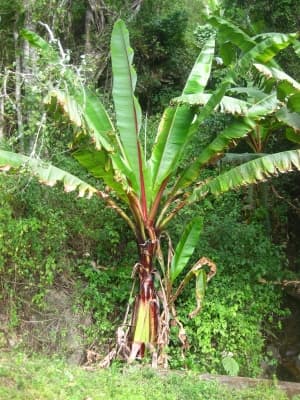
Ensete ventricosum
Ensete ventricosum
Safety & Hazards
None known
Cultivation Details
Requires a very sheltered sunny position in a fertile moisture-retentive soil[1]. This species is not very hardy in Britain but it succeeds outdoors on the Scilly Islands[2] and is sometimes used in sub-tropical bedding[3]. Plants can survive light frosts but they require ample shelter from the wind[4]. It should be possible to grow plants in tubs, keeping them outdoors in the summer and bringing them into a greenhouse or conservatory in the winter[PFAF]. The leaves can be up to 6 metres long[5].
Propagation
Sow the large seed in individual pots in a heated greenhouse at any time of the year. Pre-soak the seed for 24 hours in warm water beforehand[1]. Germination should take place within 3 months. Grow on the plants for at least a couple of winters in the greenhouse before attempting to grow them outdoors. Division of suckers in spring. Try to get as much of the sucker's roots out as possible without disturbing the main plant too much. Pot the suckers up and grow them on in light shade in the greenhouse until they are established. Cite as: Temperate Plants Database, Ken Fern. temperate.theferns.info. 2026-02-21. <temperate.theferns.info/plant/Ensete+ventricosum>
Pollinators
Data unavailable
References
- [1]The New RHS Dictionary of Gardening. 1992. — Huxley. A. · MacMillan Press · 1992 · ISBN 0-333-47494-5 ↩︎Excellent and very comprehensive, though it contains a number of silly mistakes. Readable yet also very detailed.
- [2]Growing from Seed. Volume 2. — Rice. G. (Editor) · Thompson and Morgan. · 1988 · ISBN - ↩︎Very readable magazine with lots of information on propagation. An interesting article on Ensete ventricosum.
- [3]RHS Dictionary of Plants plus Supplement. 1956 — F. Chittendon. · Oxford University Press · 1951 · ISBN - ↩︎Comprehensive listing of species and how to grow them. Somewhat outdated, it has been replaced in 1992 by a new dictionary (see [ 200 ]).
- [4]The Milder Garden. — Taylor. J. · Dent · 1990 ↩︎A good book on plants that you didn't know could be grown outdoors in Britain.
- [5]The RHS Gardener's Encyclopedia of Plants and Flowers — Brickell. C. · Dorling Kindersley Publishers Ltd. · 1990 · ISBN 0-86318-386-7 ↩︎Excellent range of photographs, some cultivation details but very little information on plant uses.
- [6]Plants for Human Consumption. — Kunkel. G. · Koeltz Scientific Books · 1984 · ISBN 3874292169 ↩︎An excellent book for the dedicated. A comprehensive listing of Latin names with a brief list of edible parts.
- [7]Cornucopia - A Source Book of Edible Plants. — Facciola. S. · Kampong Publications · 1990 · ISBN 0-9628087-0-9 ↩︎Excellent. Contains a very wide range of conventional and unconventional food plants (including tropical) and where they can be obtained (mainly N. American nurseries but also research institutes and a lot of other nurseries from around the world.
- [8]Sturtevant's Edible Plants of the World. — Hedrick. U. P. · Dover Publications · 1972 · ISBN 0-486-20459-6 ↩︎Lots of entries, quite a lot of information in most entries and references.
- [PFAF]Plants for a Future — pfaf.org ↩︎