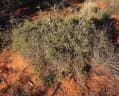
Enchylaena tomentosa
Enchylaena tomentosa
Safety & Hazards
The leaves are rich in oxalic acid. Perfectly alright in small quantities, the leaves should not be eaten in large amounts since oxalic acid can bind up the body's supply of calcium leading to nutritional deficiency. It is oxalic acid that gives foods such as rhubarb their acid flavour. Cooking the leaves will greatly reduce the oxalic acid content. People with a tendency to rheumatism, arthritis, gout, kidney stones or hyperacidity should take especial caution if including this plant in their diet since it can aggravate their condition[1].
Cultivation Details
We have very little information on this species and do not know if it will be hardy in Britain. It tolerates temperatures down to at least -7c in Australian gardens where it also resists salt spray[2]. However, this cannot be translated directly to British gardens due to our cooler summers and longer, colder and wetter winters. It might be worthwhile trying it as a summer annual and seeing if it can overwinter. It probably requires a very well-drained soil and a sunny position[PFAF]. We have overwintered the plant in a cold greenhouse, though it suffered lots of die-back, so it will obviously have problems outdoors[PFAF]. Hybridises in the wild with Maireana georgei M. turbinata.
Propagation
Seed - sow spring in a greenhouse and only just cover the seed. Prick out the seedlings as soon as they are large enough to handle and grow on for at least their first winter in a greenhouse, planting out after the last expected frosts. Give some protection for at least their first winter outdoors. It might also be possible to grow the plant as a summer annual, sowing in the spring and planting out the young plants after the last expected frosts. Cuttings. Cite as: Temperate Plants Database, Ken Fern. temperate.theferns.info. 2026-02-21. <temperate.theferns.info/plant/Enchylaena+tomentosa>
Pollinators
Data unavailable
References
- [1]Encyclopaedia of Herbs and their Uses. — Bown. D. · Dorling Kindersley, London. · 1995 · ISBN 0-7513-020-31 ↩︎A very well presented and informative book on herbs from around the globe. Plenty in it for both the casual reader and the serious student. Just one main quibble is the silly way of having two separate entries for each plant.
- [2]Australian Native Plants. — Wrigley. J. W. and Fagg. M. · Collins. (Australia) · 1988 · ISBN 0-7322-0021-0 ↩︎A lovely book, written in order to encourage Australian gardeners to grow their native plants. A little bit of information for the plant project.
- [3]Flora of Victoria. — Ewart. A. J. · University Press; Melbourne · 1930 ↩︎A flora of eastern Australia, it is rather short on information that is useful to the plant project.
- [4]Wild Food Plants of Australia. — Low. T. · Angus and Robertson. · 1989 · ISBN 0-207-14383-8 ↩︎Well presented, clear information and good photographs. An interesting read for the casual reader as well as the enthusiast
- [5]Wild Food in Australia. — Cribb. A. B. and J. W. · Fontana · 1976 · ISBN 0-00-634436-4 ↩︎A very good pocket guide.
- [6]Cornucopia - A Source Book of Edible Plants. — Facciola. S. · Kampong Publications · 1990 · ISBN 0-9628087-0-9 ↩︎Excellent. Contains a very wide range of conventional and unconventional food plants (including tropical) and where they can be obtained (mainly N. American nurseries but also research institutes and a lot of other nurseries from around the world.
- [PFAF]Plants for a Future — pfaf.org ↩︎