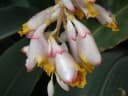
Elettaria cardamomum
Elettaria cardamomum
Safety & Hazards
None known
Cultivation Details
A plant of the moister tropics, it is usually cultivated at an elevation of 600 - 1,500 metres[1]. A uniformly distributed rainfall of 2,500 - 3,800mm per year is considered optimal, though the plant can tolerate from 1,500 - 5,800 mm[1]. Months with less than 125 mm rainfall have to be regarded as drought months[1]. Optimum annual mean temperatures are considered to be around 22°c[1]. The diurnal temperature may vary between 10 - 35°c[1]. In the lowlands, where the annual mean temperatures are above 24°c, cardamom only propagates vegetatively; the plants do not grow where annual mean temperatures are below 17°c[1]. Grows best in a rich, moist, well-drained soil in partial shade[2]. Cardamom does not tolerate prolonged exposure to direct sunlight; about 50% is thought to be optimal[1]. Evergreen montane forest land supplies the most favourable environment for cardamom, with soils varying from deep forest loam to white quartz gravel with only a shallow zone of humus accumulation[1]. Plants are intolerant of drought, failing to produce seed if short of water when forming the inflorescence or flowering, and often dying if there are 2 drought years in a row[1]. Cardamom comes into bearing about 3 years after planting out, which may be 4 - 5 years after sowing[1]. Plants can produce economic quantities of fruit for 10 - 15 years[1]. Flowers are self-sterile, therefore it is necessary to plant a mixture of clones[1]. Flowering may occur throughout the year. The flowers open from the base of the panicle upwards over a long period, sometimes even more than one year[1]. Flower buds require about 30 days from initiation to full bloom, capsule development takes a further 110 days[1]. After the panicles have flowered, fruited and died, the vegetative shoots bearing them also die off[1].
Propagation
Seed - usually germinate 5 - 7 weeks after sowing, but germination is irregular and may continue for up to one year[1]. Division Cite as: Tropical Plants Database, Ken Fern. tropical.theferns.info. 2026-02-20. <tropical.theferns.info/viewtropical.php?id=Elettaria+cardamomum>
Pollinators
Bees, ants
References
- [1]Plant Resources of Southeast Asia — http://proseanet.org/ ↩︎Lots of information on the uses of the plants of SE Asia.
- [2]Encyclopaedia of Herbs and their Uses. — Bown. D. · Dorling Kindersley, London. · 1995 · ISBN 0-7513-020-31 ↩︎A very well presented and informative book on herbs from around the globe. Plenty in it for both the casual reader and the serious student. Just one main quibble is the silly way of having two separate entries for each plant.
- [3]The Encyclopedia of Medicinal Plants — Chevallier. A. · Dorling Kindersley. London · 1996 · ISBN 9-780751-303148 ↩︎An excellent guide to over 500 of the more well known medicinal herbs from around the world.
- [4]Cornucopia II — Facciola. S. · Kampong Publications, California. · 1998 · ISBN 0-9628087-2-5 ↩︎The second edition of an excellent guide to the edible uses of plants, though it does not give any details of cultivation etc.
- [5]Dictionary of Economic Plants. — Uphof. J. C. Th. · Weinheim · 1959 · ISBN - ↩︎An excellent and very comprehensive guide but it only gives very short descriptions of the uses without any details of how to utilize the plants. Not for the casual reader.