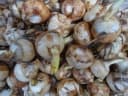
Eleocharis dulcis
Eleocharis dulcis
Safety & Hazards
None known
Cultivation Details
Eleocharis dulcis grows well in tropical and sub-tropical areas below an elevation of 1,200 metres[1]. Plants perform best at temperatures between 30 - 35°c during the leafy stage of growth, and about 5°c lower when the tubers are being formed[2]. A minimum soil/water temperature of 15°c is required for adequate development of the corms[1]. A plant of marshes and shallow water, it prefers slightly acid soil conditions and a sunny position[3]. Requires a rich fertile soil[2]. Grows best in rich clay soils[1]. Prefers a pH in the range 6.9 - 7.3[1]. Some forms can grow in brackish water[1]. Growing plants should be grown in a water depth of at least 10cm until about 20 - 30 days prior to harvesting when the land can be allowed to drain naturally[1]. The plant requires a 7 - 8 month frost-free growing season in order to produce a crop[4, 5, 1]. Yields of 20 - 40 tonnes per hectare can be achieved[1]. The tubers should be harvested at the end of the growing season and stored in a cool damp but frost-free position until replanting[2].
Propagation
Seed - we have no details for this species but suggest sowing the seed as soon as it is ripe in a greenhouse. Only just cover the seed and place the pot in 3cm of water to keep the soil wet. When they are large enough to handle, prick the seedlings out into individual pots and grow them on in the greenhouse for at least their first winter. Plant them out into their permanent positions in late spring or early summer, after the last expected frosts. Division. Harvest the tubers at the end of the growing season, store them in a cool but frost-free place over the winter and plant them out in early spring. Cite as: Temperate Plants Database, Ken Fern. temperate.theferns.info. 2026-02-21. <temperate.theferns.info/plant/Eleocharis+dulcis>
Pollinators
Data unavailable
References
- [1]Vegetables in the Tropics — Tindall. H. D. · MacMillan, Oxford. · 1983 · ISBN 0-333-24268-8 ↩︎An excellent, in-depth look at the main vegetable crops that can be grown in the Tropics, plus many less well-known plants.
- [2]Oriental Vegetables — Larkcom J. · John Murray · 1991 · ISBN 0-7195-4781-4 ↩︎Well written and very informative.
- [3]The New RHS Dictionary of Gardening. 1992. — Huxley. A. · MacMillan Press · 1992 · ISBN 0-333-47494-5 ↩︎Excellent and very comprehensive, though it contains a number of silly mistakes. Readable yet also very detailed.
- [4]Oriental Herbs and Vegetables, Vol 39 No. 2. — Brooklyn Botanic Garden · Brooklyn Botanic Garden · 1986 · ISBN - ↩︎A small booklet packed with information.
- [5]The Book of Edible Nuts. — Rosengarten. jnr. F. · Walker & Co. · 1984 · ISBN 0802707699 ↩︎A very readable and comprehensive guide. Well illustrated.
- [6]Cornucopia - A Source Book of Edible Plants. — Facciola. S. · Kampong Publications · 1990 · ISBN 0-9628087-0-9 ↩︎Excellent. Contains a very wide range of conventional and unconventional food plants (including tropical) and where they can be obtained (mainly N. American nurseries but also research institutes and a lot of other nurseries from around the world.
- [7]Wild Food Plants of Australia. — Low. T. · Angus and Robertson. · 1989 · ISBN 0-207-14383-8 ↩︎Well presented, clear information and good photographs. An interesting read for the casual reader as well as the enthusiast
- [8]Sturtevant's Edible Plants of the World. — Hedrick. U. P. · Dover Publications · 1972 · ISBN 0-486-20459-6 ↩︎Lots of entries, quite a lot of information in most entries and references.
- [9]Dictionary of Economic Plants. — Uphof. J. C. Th. · Weinheim · 1959 · ISBN - ↩︎An excellent and very comprehensive guide but it only gives very short descriptions of the uses without any details of how to utilize the plants. Not for the casual reader.
- [10]A Dictionary of Plants Used by Man. — Usher. G. · Constable · 1974 · ISBN 0094579202 ↩︎Forget the sexist title, this is one of the best books on the subject. Lists a very extensive range of useful plants from around the world with very brief details of the uses. Not for the casual reader.
- [11]Nuts. — Howes. F. N. · Faber · 1948 · ISBN - ↩︎Rather old but still a masterpiece. Has sections on tropical and temperate plants with edible nuts plus a section on nut plants in Britain. Very readable.
- [12]Flowering Plants of the World. — Haywood. V. H. · Oxford University Press · ISBN 0-19-217674-9 ↩︎Very readable and well illustrated, it lists plants by families giving the basic diagnostic features and some details of plant uses.
- [13]Tropical Food Gardens — Norrington. L. · Bloomings Books (Melbourne) · 2001 · ISBN 1-876473-41-x ↩︎Excellent little book giving some basic information on a range of plants.
- [14]Medicinal Plants of China — Duke. J. A. and Ayensu. E. S. · Reference Publications, Inc. · 1985 · ISBN 0-917256-20-4 ↩︎Details of over 1,200 medicinal plants of China and brief details of their uses. Often includes an analysis, or at least a list of constituents. Heavy going if you are not into the subject.
- [15]The Useful Plants of the Island of Guam — Safford W.E. · Smithsonian Institute; Washington. · 1905 · http://www.biodiversitylibrary.org/ ↩︎A very comprehensive, if rather dated, guide to the plants of Guam. It can be downloaded from the Internet.