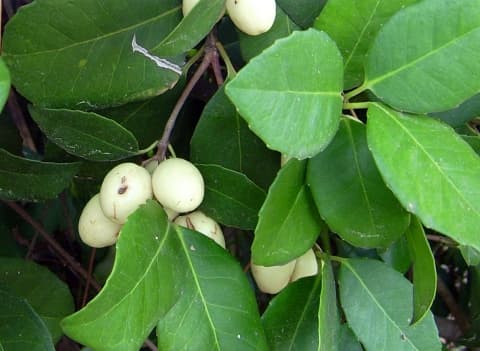
Cultivation Details
When growing in wet conditions, the outer portion of the bark breaks off more frequently, exposing the characteristic yellow pigments that the species shares with other Celastraceae such as Cassine peragua and Pterocelastrus echinatus. The yellow bark is then remarkably conspicuous[2]. The tree is not usually a fast grower[2]. Young plants tend to grow very slowly or remain straggly for a long period, but this could be an adaptation to forest conditions where sun and space are limited[2].
Propagation
Seed - easy to germinate. If the stone covering of the seed is not removed or broken, germination can take anything from 12 - 30 months[2]. Cite as: Tropical Plants Database, Ken Fern. tropical.theferns.info. 2026-02-20. <tropical.theferns.info/viewtropical.php?id=Elaeodendron+croceum>
Pollinators
Data unavailable
References
- [1]African Flowering Plants Database — Conservatoire et Jardin Botaniques. · http://www.ville-ge.ch/musinfo/bd/cjb/africa/recherche.php ↩︎Contains information on over 150,000 plant names (including synonyms) giving a description and habitat, plus a distribution map.
- [2]PlantZAfrica.com — http://www.plantzafrica.com ↩︎An excellent site giving detailed descriptions and uses of many S. African plants.
- [3]Protabase - Plant Resources of Tropical Africa. — http://www.prota.org ↩︎An excellent on-line database with detailed information on over 3,200 species of useful plants of Africa.
- [4]Flora Capensis — Hiern. W.P.; Brown N.E. · 1909 · http://www.aluka.org/action/doBrowse?sa=1&st=662543&execbr=&sls= ↩︎Rather dated, and many of the botanical names have been changed since it was written, but contains a wealth of information about plants of southern Africa. It can be downloaded or viewed online.
- [PFAF]Plants for a Future — pfaf.org ↩︎