Elaeocarpus angustifolius
Elaeocarpus angustifolius
Safety & Hazards
None known
Cultivation Details
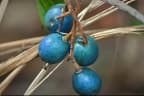
A plant of the moist lowland tropics and subtropics, where it is found at elevations up to 500 metres. It grows best in areas where annual daytime temperatures are within the range 18 - 28°c, but can tolerate 8 - 38°c[1]. It prefers a mean annual rainfall in the range 1,500 - 3,000mm, but tolerates 1,000 - 3,500mm[1]. Prefers a position in full sun but tolerates some shade[1]. Prefers a fertile, humus-rich, moisture-retentive but well-drained soil[2]. Prefers a pH in the range 5.5 - 6.5, tolerating 4.5 - 7.5[1]. One of the fastest-growing species in the Australian rainforest[3]. The fruits of this species are a brilliant, iridescent blue-a colour produced not by anthocyanin pigments as in other blue fruits, but by physical interference. In the epidermal cells of the fruits, cellulose layers form a special structure outside the cell membrane but inside the cell wall. The layers create constructive thin-film interference with blue light (thus reflecting the blue colour)[3]. The trees are sometimes partially ring-barked. This results in the tree producing smaller than normal seeds - these smaller seeds are more highly valued for decorative purposes that the usual sized seeds[4].
Propagation
The seed of most species in this genus is covered by a hard, woody shell and can be very slow and erratic to germinate, sometimes taking 2 years or more. Filing down the shell, or cracking it (being very careful not to damage the seed) in order to allow the ingress of moisture can help to greatly speed up germination. Sow the seed in containers in light shade. When the seedlings are large enough to handle, prick them out into individual pots and grow them on until large enough to plant out, Cuttings of almost ripe shoots, in a sandy soil in a frame. The leaves should be left on the stem.[5, 2]. Many species strike readily from cuttings. Cite as: Tropical Plants Database, Ken Fern. tropical.theferns.info. 2026-02-20. <tropical.theferns.info/viewtropical.php?id=Elaeocarpus+angustifolius>
Pollinators
Data unavailable
References
- [1]Ecocrop — http://ecocrop.fao.org/ecocrop/srv/en/home ↩︎Basic information on a wide range of useful plants, plus details of environmental needs where available.
- [2]The New RHS Dictionary of Gardening. 1992. — Huxley. A. · MacMillan Press · 1992 · ISBN 0-333-47494-5 ↩︎Excellent and very comprehensive, though it contains a number of silly mistakes. Readable yet also very detailed.
- [3]Australian Tropical Rainforest Plants — http://www.anbg.gov.au/cpbr/cd-keys/rfk/index.html ↩︎An online resource giving botanical information, and a little bit about plant usage, for over 2,700 species of plants found in the Australian rainforest.
- [4]Annals of the Missouri Botanical Garden Vol. 54 — Missouri Botanical Garden · 1967 ↩︎An excellent botanical publication, available for download from the Internet. This volume contains parts of the Flora of Panama.
- [5]RHS Dictionary of Plants plus Supplement. 1956 — F. Chittendon. · Oxford University Press · 1951 · ISBN - ↩︎Comprehensive listing of species and how to grow them. Somewhat outdated, it has been replaced in 1992 by a new dictionary (see [ 200 ]).
- [6]Flora of China — Missouri Botanical Garden Press; St. Louis. · 1994 · http://flora.huh.harvard.edu/china/ ↩︎An excellent, comprehensive resource in 25 volumes. In addition to the botanical information the flora also gives basic information on habitat and some uses. An on-line version is also available.
- [7]Endemia.nc — http://www.endemia.nc/flore/ ↩︎A web site focussing on the endemic flora and fauna of New Caledonia.
- [8]Plant Resources of Southeast Asia — http://proseanet.org/ ↩︎Lots of information on the uses of the plants of SE Asia.
- [9]Dictionary of Economic Plants. — Uphof. J. C. Th. · Weinheim · 1959 · ISBN - ↩︎An excellent and very comprehensive guide but it only gives very short descriptions of the uses without any details of how to utilize the plants. Not for the casual reader.
- [10]Plants and People of Nepal — Manandhar. N. P. · Timber Press. Oregon. · 2002 · ISBN 0-88192-527-6 ↩︎Excellent book, covering over 1,500 species of useful plants from Nepal together with information on the geography and peoples of Nepal. Good descriptions of the plants with terse notes on their uses.
- [11]Glossary of Indian Medicinal Plants (Including the Supplement). — Chopra. R. N., Nayar. S. L. and Chopra. I. C. · Council of Scientific and Industrial Research, New Delhi. · 1986 · ISBN - ↩︎Very terse details of medicinal uses of plants with a wide range of references and details of research into the plants chemistry. Not for the casual reader.
- [12]Mansfeld's Database of Agricultural and Horticultural Plants — http://mansfeld.ipk-gatersleben.de/pls/htmldb_pgrc/f?p=185:3:4292127278597336 ↩︎Terse details of a huge range of useful plants.
- [13]Cornucopia II — Facciola. S. · Kampong Publications, California. · 1998 · ISBN 0-9628087-2-5 ↩︎The second edition of an excellent guide to the edible uses of plants, though it does not give any details of cultivation etc.
- [14]A Dictionary of Malaysian Timbers — Wong T.M. · Forest Research Institute Malaysia; Kuala Lumpur · 2002 · http://Elaeocarpaceae · ISBN 983-2181-29-1 ↩︎A fairly comprehensive guide to Malaysian timbers, giving their properties and the main tree species from which they are obtained.