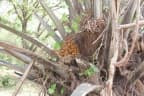
Elaeis oleifera
Elaeis oleifera
Safety & Hazards
None known
Cultivation Details
A plant of the lowland, moist tropics, where it is found at elevations up to 510 metres. It grows best in areas where annual daytime temperatures are within the range 20 - 30°c, but can tolerate 14 - 34°c[1]. It can be killed by temperatures of 8°c or lower[1]. It prefers a mean annual rainfall in the range 1,400 - 2,500mm, but tolerates 700 - 3,500mm[1]. Plants grow well in full sun, even when small[2]. Requires a humus-rich, well-drained soil, but is not fussy as to soil type[2, 3, 1]. Prefers a pH in the range 5.5 - 6.5, tolerating 5 - 7.3[1]. A slow growing tree[1]. Plants can commence bearing just 3 years after the seed has germinated[2]. The plant produces both male and female flowers, but not usually at the same time. An individual inflorescence will be all male or all female flowers; after a series of inflorescences of one sex the plant will then produce a series of inflorescences of the opposite sex[4].
Propagation
Seed - pre-soak 24 hours in warm water and sow in containers. Germination takes place in 2 - 5 months[2]. Cite as: Tropical Plants Database, Ken Fern. tropical.theferns.info. 2026-02-20. <tropical.theferns.info/viewtropical.php?id=Elaeis+oleifera>
Pollinators
Data unavailable
References
- [1]Ecocrop — http://ecocrop.fao.org/ecocrop/srv/en/home ↩︎Basic information on a wide range of useful plants, plus details of environmental needs where available.
- [2]Palms of the World — Blombery. A. & Rodd. T. · Angus and Robertson · 1992 · ISBN 0-207-14848-1 ↩︎An excellent guide, well illustrated, with information on cultivation, uses, habitat etc of almost 200 species of Palms.
- [3]Palm and Cycad Societies of Australia. — http://www.pacsoa.org.au/ ↩︎Contains at least a little information on the majority of palm and cycad species, plus a wealth of photographs. A first class website.
- [4]Field Guide to the Palms of the Americas — Henderson A.; Galeano G.; Bernal R. · Princeton University Press; Princeton, New Jersey. · 1995 · ISBN 0-691-08537-4 ↩︎An excellent book, giving basic information on all the 550 species of palms native to the Americas that were known in 1995. Comprehensive information on the plants range and habitat, brief description, some uses and almost 250 photos.
- [5]Medicinal Plants of Brazil — Mors W.B.; Rizzini C.T.; Pereira N.A. · Reference Publications; Michigan. · 2000 · ISBN 0-917256-42-5 ↩︎An extremely concise book, listing approximately 1,500 species and varieties of plants with their botanical name, common name in Brazil, regions in Brazil where the plant is found, a brief list of uses and any medically active compounds in the plant.