Elaeis guineensis
Elaeis guineensis
Safety & Hazards
None known
Cultivation Details
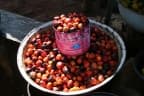
Plants succeed in moist to very wet tropical climates up to elevations of 1,300 metres, though commercial cultivation is restricted to areas below 700 metres and preferably lower than 300 metres[1]. It grows best in areas where annual daytime temperatures are within the range 20 - 35°c, but can tolerate 12 - 38°c[2]. The plant is quite tolerant, though, and succeeds in southern China where there are light frosts and mean daily temperatures can drop below 10°c for weeks on end[1]. It prefers a mean annual rainfall in the range 1,500 - 3,000mm, but tolerates 1,000 - 8,000mm[2]. Optimally, there should be at least 150 mm of rain each month of the year, ideally falling mostly at night[1]. Plants grow well in full sun, even when small[3]. Grows and thrives on wide range of tropical soils, provided they have adequate water supply[1]. Requires a humus-rich soil[3]. Waterlogged, highly lateritic, extremely sandy, stony or peaty soils should be avoided[1]. Tolerant of temporary flooding, provided the water is not stagnant[1]. Prefers a pH in the range 4.5 - 6, tolerating 3.2 - 8[2]. The root system is adventitious, forming a dense mat with a radius of 3 - 5 metres in the upper 40 - 60cm of the soil. Some primary roots are directly below the base of the trunk descending for anchorage for more than 1.5 metres; the roots produce pneumatodes under very moist conditions[4]. The African oil palm is a succession species favoured by slash and burn, and its gene pool has expanded as farmers clear land and create more open habitat for the germination of its seeds[1]. Plants can commence bearing just 3 years after the seed has germinated[3]. The plant produces both male and female flowers, but not usually at the same time. An individual inflorescence will be all male or all female flowers; after a series of inflorescences of one sex the plant will then produce a series of inflorescences of the opposite sex[5]. Plants flower all year round[6]. The fruit is produced in clusters of about 100 fruits[6]. The inflorescence is produced from about every second leaf axil. There are up to 1,500 deep violet fruits (ripening to orange-red) in each roundish dense cluster, weighing 30 kg or more[7]. Yields of 5 tonnes of oil per hectare have been obtained from mature plants[3].
Propagation
Seed - pre-soak 24 hours in warm water and sow in containers. Germination takes place in 2 - 5 months[3]. Commercially, the seeds are placed in intact 500-gauge polythene bags arranged on wooden boxes in a germinator at 39-40 deg. C for 75-80 days. They are then soaked in cold water for 3 days, changing water every 24 hours. The seeds are drained and dried under shade and kept at room temperature. They are examined every 2 weeks for germination and drying. Drying seeds are sprayed with water; germinated seeds are picked for potting. This treatment gives an 80% germination rate[1]. Cite as: Tropical Plants Database, Ken Fern. tropical.theferns.info. 2026-02-20. <tropical.theferns.info/viewtropical.php?id=Elaeis+guineensis>
Pollinators
Insects
References
- [1]World Agroforesty Centre — http://www.worldagroforestry.org/ ↩︎An excellent online database of a huge range of trees giving very good information on each plant - its uses, ecology, identity, propagation, pests etc.
- [2]Ecocrop — http://ecocrop.fao.org/ecocrop/srv/en/home ↩︎Basic information on a wide range of useful plants, plus details of environmental needs where available.
- [3]Palms of the World — Blombery. A. & Rodd. T. · Angus and Robertson · 1992 · ISBN 0-207-14848-1 ↩︎An excellent guide, well illustrated, with information on cultivation, uses, habitat etc of almost 200 species of Palms.
- [4]Protabase - Plant Resources of Tropical Africa. — http://www.prota.org ↩︎An excellent on-line database with detailed information on over 3,200 species of useful plants of Africa.
- [5]Field Guide to the Palms of the Americas — Henderson A.; Galeano G.; Bernal R. · Princeton University Press; Princeton, New Jersey. · 1995 · ISBN 0-691-08537-4 ↩︎An excellent book, giving basic information on all the 550 species of palms native to the Americas that were known in 1995. Comprehensive information on the plants range and habitat, brief description, some uses and almost 250 photos.
- [6]Perennial Edible Fruits of the Tropics : an Inventory — Martin, F. W.; Campbell, C. W.; Rubertbe, R. M. · U.S. Dept. of Agriculture, Agricultural Research Service · 1987 ↩︎A booklet giving terse details of almost 300 species of edible fruits, plus regional lists of Botanical and Common names for over 2,500 less well-known edible fruits of the tropics.
- [7]Trees Commonly Cultivated in SE Asia — Jensen. M. · FAO Regional Office, Bangkok. · 1999 · ISBN 974-89377-5-5 ↩︎
- [8]Cornucopia II — Facciola. S. · Kampong Publications, California. · 1998 · ISBN 0-9628087-2-5 ↩︎The second edition of an excellent guide to the edible uses of plants, though it does not give any details of cultivation etc.
- [9]Medicinal Plants of Brazil — Mors W.B.; Rizzini C.T.; Pereira N.A. · Reference Publications; Michigan. · 2000 · ISBN 0-917256-42-5 ↩︎An extremely concise book, listing approximately 1,500 species and varieties of plants with their botanical name, common name in Brazil, regions in Brazil where the plant is found, a brief list of uses and any medically active compounds in the plant.
- [10]Dictionary of Economic Plants. — Uphof. J. C. Th. · Weinheim · 1959 · ISBN - ↩︎An excellent and very comprehensive guide but it only gives very short descriptions of the uses without any details of how to utilize the plants. Not for the casual reader.
- [11]Useful Fiber Plants of the World — Dodge C.R. · USDA; Washington. · 1897 · http://www.biodiversitylibrary.org/ ↩︎A rather dated, but very comprehensive catalogue of fibre plants from around the world. The book can be downloaded from the Internet.
- [PFAF]Plants for a Future — pfaf.org ↩︎