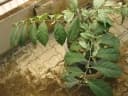
Elaeagnus latifolia
Elaeagnus latifolia
Safety & Hazards
None known
Cultivation Details
Elaeagnus latifolia is a plant of the subtropical and warm temperate zones, though it can also be found at higher elevations in the tropics. Succeeds in most soils that are well-drained[1]. Prefers a soil that is only moderately fertile, succeeding in poor soils and in dry soils[2, 1]. Plants can commence fruiting when around 2 years old[3]. Plants can yield 10 - 15 kilos of fruit annually[3]. This species is notably resistant to honey fungus[4, 1]. This species has a symbiotic relationship with certain soil bacteria, these bacteria form nodules on the roots and fix atmospheric nitrogen. Some of this nitrogen is utilized by the growing plant but some can also be used by other plants growing nearby[1]. An excellent companion plant, when grown in orchards it can increase yields from the fruit trees by up to 10%.
Propagation
Seed - it has a short viability and so is best sown as soon as it is ripe in a cold frame[5, 3]. It should germinate in late winter or early spring, though it may take 18 months[PFAF]. Stored seed can be very slow to germinate, often taking more than 18 months. A warm stratification for 4 weeks followed by 12 weeks cold stratification can help[6]. (This information on stratification is probably not appropriate to this species since it does not experience much frost in its native habitat[PFAF]). The seed usually (eventually) germinates quite well[5]. Prick out the seedlings into individual pot as soon as they are large enough to handle and plant out when they are at least 15cm tall. Cuttings of half-ripe wood, 7 - 10cm with a heel, mid summer in a frame. Cuttings of mature wood of the current year's growth, 10 - 12cm with a heel, autumn in a frame[1]. The cuttings are rather slow and difficult to root, leave them for 12 months[7]. Layering in September/early autumn. Takes 12 months[5]. Cite as: Temperate Plants Database, Ken Fern. temperate.theferns.info. 2026-02-21. <temperate.theferns.info/plant/Elaeagnus+latifolia>
Pollinators
Bees
References
- [1]The New RHS Dictionary of Gardening. 1992. — Huxley. A. · MacMillan Press · 1992 · ISBN 0-333-47494-5 ↩︎Excellent and very comprehensive, though it contains a number of silly mistakes. Readable yet also very detailed.
- [2]Trees and Shrubs Hardy in Great Britain. Vol 1 - 4 and Supplement. — Bean. W. · Murray · 1981 · ISBN - ↩︎A classic with a wealth of information on the plants, but poor on pictures.
- [3]Soh-Shang (Elaeagnus latifolia): An Under-utilized Fruit of North East Region needs Domestication — R. K Patel; A. Singh; B.C. Deka · 2008 ↩︎A brief article on the edible uses and potential for cultivation of Elaeagnus latifolia
- [4]The Garden. Volume 112. — RHS. · Royal Horticultural Society · 1987 · ISBN - ↩︎Snippets of information from the magazine of the RHS. In particular, there are articles on plants that are resistant to honey fungus, oriental vegetables, Cimicifuga spp, Passiflora species and Cucurbits.
- [5]Propagation of Trees, Shrubs and Conifers. — Sheat. W. G. · MacMillan and Co · 1948 · ISBN - ↩︎A bit dated but a good book on propagation techniques with specific details for a wide range of plants.
- [6]Seed Manual for Ornamental Trees and Shrubs. — Gordon. A. G. and Rowe. D. C. F. · HMSO; London · 1982 · ISBN 0-11-710152-4 ↩︎Very comprehensive guide to growing trees and shrubs from seed. Not for the casual reader.
- [7]The Reference Manual of Woody Plant Propagation. — Dirr. M. A. and Heuser. M. W. · Athens Ga. Varsity Press · 1987 · ISBN 0942375009 ↩︎A very detailed book on propagating trees. Not for the casual reader.
- [8]A Manual of Indian Timbers. — Gamble. J. S. · Bishen Singh Mahendra Pal Singh · 1972 · ISBN - ↩︎First written in the 19th century, but still a classic, giving a lot of information on the uses and habitats of Indian trees. Not for the casual reader.
- [9]Forest Flora of Chakrata, Dehra Dun and Saharanpur. — Gupta. B. L. · Forest Research Institute Press · 1945 · ISBN - ↩︎A good flora for the middle Himalayan forests, sparsly illustrated. Not really for the casual reader.
- [10]Plants and People of Nepal — Manandhar. N. P. · Timber Press. Oregon. · 2002 · ISBN 0-88192-527-6 ↩︎Excellent book, covering over 1,500 species of useful plants from Nepal together with information on the geography and peoples of Nepal. Good descriptions of the plants with terse notes on their uses.
- [11]Cornucopia - A Source Book of Edible Plants. — Facciola. S. · Kampong Publications · 1990 · ISBN 0-9628087-0-9 ↩︎Excellent. Contains a very wide range of conventional and unconventional food plants (including tropical) and where they can be obtained (mainly N. American nurseries but also research institutes and a lot of other nurseries from around the world.
- [12]Glossary of Indian Medicinal Plants (Including the Supplement). — Chopra. R. N., Nayar. S. L. and Chopra. I. C. · Council of Scientific and Industrial Research, New Delhi. · 1986 · ISBN - ↩︎Very terse details of medicinal uses of plants with a wide range of references and details of research into the plants chemistry. Not for the casual reader.
- [13]Medicinal Plants of Nepal — Dept. of Medicinal Plants. Nepal. · 1993 · ISBN - ↩︎Terse details of the medicinal properties of Nepalese plants, including cultivated species and a few imported herbs.
- [14]The New Plantsman. Volume 1, 1994. — Matthews. V. · Royal Horticultural Society · 1994 · ISBN 1352-4186 ↩︎A quarterly magazine, it has articles on Himalayacalamus hookerianus, hardy Euphorbias and an excellent article on Hippophae spp.
- [PFAF]Plants for a Future — pfaf.org ↩︎