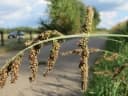
Echinochloa crus-galli
Echinochloa crus-galli
Cultivation Details
Barnyard millet is an annual plant that can succeed in a wide range of environments from the temperate zone to the tropics. It can be found at elevations up to 2,500 metres. It grows best in areas where annual daytime temperatures are within the range 17 - 30°c, but can tolerate 2 - 40°c[2]. It prefers a mean annual rainfall in the range 700 - 1,100mm, but tolerates 310 - 2,500mm[2]. An easily grown plant, it is adapted to nearly all types of wet places, and is often a common weed in paddy fields, roadsides, cultivated areas, and fallow fields[1]. It succeeds on a variety of wet sites such as ditches, low areas in fertile croplands and wet wastes, often growing in water[1]. Tolerant of most soil types, including saline conditions, plants are not restricted by soil pH[1]. Prefers a rich moist soil[3] but succeeds in ordinary garden soil[4]. The sub-species E. Crus-galli zelayensis is often found growing wild in alkaline soils[5]. Prefers a pH in the range 6 - 7, tolerating 4.8 - 8.2[2]. The plant has a relatively long growing season.
Propagation
Seed - sow early spring in a greenhouse and only just cover the seed. When they are large enough to handle, prick the seedlings out into individual pots and plant them out into their permanent positions in early summer. A sowing in situ in late spring might also succeed but is unlikely to ripen a crop of seed if the summer is cool and wet. Cite as: Temperate Plants Database, Ken Fern. temperate.theferns.info. 2026-02-21. <temperate.theferns.info/plant/Echinochloa+crus-galli>
Pollinators
Wind
References
- [1]Handbook of Energy Crops — Duke. J. · - · 1983 · https://hort.purdue.edu/newcrop/duke_energy/dukeindex.html · ISBN - ↩︎Published only on the Internet, excellent information on a wide range of both temperate and tropical plants.
- [2]Ecocrop — http://ecocrop.fao.org/ecocrop/srv/en/home ↩︎Basic information on a wide range of useful plants, plus details of environmental needs where available.
- [3]Edible Native Plants of the Rocky Mountains. — Harrington. H. D. · University of New Mexico Press · 1967 · ISBN 0-8623-0343-9 ↩︎A superb book. Very readable, it gives the results of the authors experiments with native edible plants.
- [4]RHS Dictionary of Plants plus Supplement. 1956 — F. Chittendon. · Oxford University Press · 1951 · ISBN - ↩︎Comprehensive listing of species and how to grow them. Somewhat outdated, it has been replaced in 1992 by a new dictionary (see [ 200 ]).
- [5]Manual of the Grasses of the United States — Hitchcock. A. S. · Dover Publications. New York. · 1971 · ISBN 0-486-22717-0 ↩︎A nice and comprehensive flora, though a bit dated. Good line drawings of each plant, plus a brief idea of the habitat and a few notes on plant uses. Not for the casual reader.
- [6]Economic Botany. — Hill. A. F. · The Maple Press · 1952 · ISBN - ↩︎Not very comprehensive, but it is quite readable and goes into some detail about the plants it does cover.
- [7]Plant Resources of Southeast Asia — http://proseanet.org/ ↩︎Lots of information on the uses of the plants of SE Asia.
- [8]Flora Europaea — ? · Cambridge University Press · 1964 · ISBN - ↩︎An immense work in 6 volumes (including the index). The standard reference flora for Europe, it is very terse though and with very little extra information. Not for the casual reader.
- [9]Glossary of Indian Medicinal Plants (Including the Supplement). — Chopra. R. N., Nayar. S. L. and Chopra. I. C. · Council of Scientific and Industrial Research, New Delhi. · 1986 · ISBN - ↩︎Very terse details of medicinal uses of plants with a wide range of references and details of research into the plants chemistry. Not for the casual reader.
- [10]Herbal Review. Vol.11. 4. — The Herb Society · The Herb Society · 1986 · ISBN 0264-9853 ↩︎
- [11]Eat the Weeds. — Harris. B. C. · Pivot Health · 1973 · ISBN - ↩︎Interesting reading.
- [12]Tanaka's Cyclopedia of Edible Plants of the World. — Tanaka. T. & Nakao S. · Keigaku Publishing; Tokyo · 1976 · ISBN - ↩︎The most comprehensive list of edible plants I've come across. Only the briefest entry for each species, though, and some of the entries are more than a little dubious. Not for the casual reader.
- [13]Cornucopia - A Source Book of Edible Plants. — Facciola. S. · Kampong Publications · 1990 · ISBN 0-9628087-0-9 ↩︎Excellent. Contains a very wide range of conventional and unconventional food plants (including tropical) and where they can be obtained (mainly N. American nurseries but also research institutes and a lot of other nurseries from around the world.
- [14]Native American Ethnobotany — Moerman. D. · Timber Press. Oregon. · 1998 · ISBN 0-88192-453-9 ↩︎Very comprehensive but terse guide to the native uses of plants. Excellent bibliography, fully referenced to each plant, giving a pathway to further information. Not for the casual reader.
- [15]Wild Food Plants of Indiana. — McPherson. A. and S. · Indiana University Press · 1977 · ISBN 0-253-28925-4 ↩︎A nice pocket guide to this region of America.
- [16]Chinese Materia Medica. — Stuart. Rev. G. A. · Taipei. Southern Materials Centre · 1911 · ISBN - ↩︎A translation of an ancient Chinese herbal. Fascinating.
- [17]Wild Food in Australia. — Cribb. A. B. and J. W. · Fontana · 1976 · ISBN 0-00-634436-4 ↩︎A very good pocket guide.
- [18]Plants for Human Consumption. — Kunkel. G. · Koeltz Scientific Books · 1984 · ISBN 3874292169 ↩︎An excellent book for the dedicated. A comprehensive listing of Latin names with a brief list of edible parts.
- [19]Medicinal Plants of China — Duke. J. A. and Ayensu. E. S. · Reference Publications, Inc. · 1985 · ISBN 0-917256-20-4 ↩︎Details of over 1,200 medicinal plants of China and brief details of their uses. Often includes an analysis, or at least a list of constituents. Heavy going if you are not into the subject.
- [PFAF]Plants for a Future — pfaf.org ↩︎