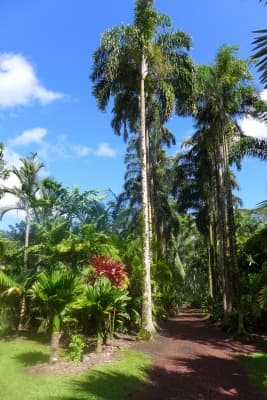
Dypsis madagascariensis
Dypsis madagascariensis
Safety & Hazards
None known
Cultivation Details
Grows best in a sunny position or in light shade, in a well-drained soil[1, 2]. The plant has sometimes escaped from cultivation and has become locally naturalized in some areas, such as in Panama[3]. A fast growing palm which does well in cultivation[1]. Several other large-sized Dypsis species are cut for their timber used in house building, but most of these are very rare or have a very restricted distribution. The stems of some smaller-sized species are used to make blowpipes, fishtraps and bird cages[3].
Propagation
Seed - germinates easily when fresh[2]. Pre-soak the seeds in water for 3 days prior to sowing - germination should then start within 2 weeks with up to 90% of the seeds sprouting. Growth is fast, with seedlings reaching a height of around 120 cm after one year, by which time they are ready to plant out[3]. Cite as: Tropical Plants Database, Ken Fern. tropical.theferns.info. 2026-02-20. <tropical.theferns.info/viewtropical.php?id=Dypsis+madagascariensis>
Pollinators
Data unavailable
References
- [1]Palm and Cycad Societies of Australia. — http://www.pacsoa.org.au/ ↩︎Contains at least a little information on the majority of palm and cycad species, plus a wealth of photographs. A first class website.
- [2]Desert Tropicals — http://www.desert-tropicals.com/ ↩︎The main focus of the site is succulent plants, but it also contains information on a wide range of other species. Usually at least one good photograph, plus basic information about the plant and its cultivation.
- [3]Protabase - Plant Resources of Tropical Africa. — http://www.prota.org ↩︎An excellent on-line database with detailed information on over 3,200 species of useful plants of Africa.
- [4]Heart of Palm Use: A Family Survey — Scott Zona, Ph.D. · Fairchild Tropical Botanic Garden, Virtual Herbarium. · http://www.virtualherbarium.org/palmresearch/Hearts_of_Palm_table.html ↩︎An on-line article listing the botanical names and range of palm trees that have an edible apical bud.
- [5]Assessing Ethnobotanical Knowledge and Resources, Lokaro Reserve, SE Madagascar — Lehman A.D. · 2009 ↩︎A thesis, in PDF format, by Ashley Davis Lehman of the University of Montana, Missoula, MT.
- [PFAF]Plants for a Future — pfaf.org ↩︎