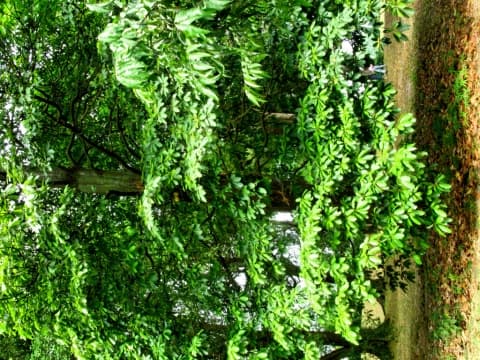
Apocynaceae FAMILY Endangered
Dyera polyphylla
Dyera polyphylla
Edibility
0/5
Medicinal
0/5
Safety & Hazards
None known
Cultivation Details
HabitTree
Growth—
The plant is often found in the wild in Kerangas forest - a type of moist, heath forest found on acidic, sandy soils that are low in nutrients, especially nitrogen[PFAF]. There is some plantation development in Sarawak and Kalimantan. In southern Kalimatan, line plantation of D. Polyphylla by the local population needed thinning two years after planting to provide more light for the planted stumps[1]. Tapping of plantation-grown trees may start 30 - 35 years after planting, when trees reach a diameter of about 35 cm[1].
Propagation
Seed - Cite as: Tropical Plants Database, Ken Fern. tropical.theferns.info. 2026-02-20. <tropical.theferns.info/viewtropical.php?id=Dyera+polyphylla>
Pollinators
Data unavailable
References
- [1]Strategies for the Sustaibable Use and Management of Timber Trees - SE Asia. — UNEP; Cambridge, UK. · 2007 · http://www.unep-wcmc.org/forest/timber/workshops/pdf/SEAsia_2007_V2.pdf ↩︎A draft document in PDF format, available on the Internet. It gives brief details on habitat, uses etc of over 100 species of trees from SE Aia.
- [2]Forest Stewardship Council. — http://www.fsc.dk/index.php?id=256&PHPSESSID=367043b95e93a891cf96369e9264cd03 ↩︎The site contains information on the properties of some less well-known tropical timbers. The Forest Stewardship Council works actively to protect tropical forests by encouraging sustainable harvesting of the trees.
- [3]Tropix 7 — CIRAD · http://tropix.cirad.fr/en ↩︎An on-line guide to the timbers of 245 species of trees.
- [PFAF]Plants for a Future — pfaf.org ↩︎