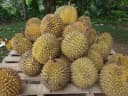
Durio zibethinus
Durio zibethinus
Safety & Hazards
None known
Cultivation Details
Durian is a strictly tropical plant, growing successfully at elevations up to 800 metres near the equator, and up to 18° from it in Thailand and Australia[1]. At its further distances from the equators, extension growth comes to a halt during the coolest months, when mean temperatures fall below 22°c[1]. It grows best in areas where annual daytime temperatures are within the range 22 - 40°c, but can tolerate 12 - 45°c[2]. It prefers a mean annual rainfall in the range 1,500 - 2,500mm, but tolerates 1,200 - 3,500mm[2]. The tree needs abundant, well-distributed rainfall but it can tolerate 2 - 3 dry months[1]. Flowering and fruiting appear to be more prolific when the plant is grown in a more seasonal climate, as found at further distances from the equator[1]. Prefers a sunny position in a deep, fertile, humus-rich loamy soil[3]. Young trees should be given up to 50% shade, gradually reducing it as they grow larger[1]. Prefers a pH in the range 5 - 6.5, tolerating 4.3 - 7.5[2]. Seedling trees can commence cropping when about 7 - 8 years old, whilst grafted specimens can commence when 3 - 4 years old[4]. Durio species usually flower once or twice a year[1], though some specimens are known that flower all year round[4]. The bisexual flowers open during the night and are pollinated mainly by moths and other night-flying insects. Production of the fruit is seasonal and is prone to alternate bearing[1]. Trees bear fruit best on limbs that are more or less horizontal; upright limbs contribute more to tree size and height[1]. Pruning dominant upright laterals to maintain 1 central leader is essential[1].
Propagation
Seed - it has a short viability and so is best sown as soon as it is ripe in containers at a temperature of 22°c[3]. Germination is usually very good, taking 3 - 8 days[5]. The seed can also be sown directly into its permanent position[1]. Seedling trees only take about 7 years before beginning to bear fruit[3]. Seeds are recalcitrant; they lose viability within 2 weeks[1]. Grafting. Cite as: Tropical Plants Database, Ken Fern. tropical.theferns.info. 2026-02-20. <tropical.theferns.info/viewtropical.php?id=Durio+zibethinus>
Pollinators
Moths
References
- [1]World Agroforesty Centre — http://www.worldagroforestry.org/ ↩︎An excellent online database of a huge range of trees giving very good information on each plant - its uses, ecology, identity, propagation, pests etc.
- [2]Ecocrop — http://ecocrop.fao.org/ecocrop/srv/en/home ↩︎Basic information on a wide range of useful plants, plus details of environmental needs where available.
- [3]The New RHS Dictionary of Gardening. 1992. — Huxley. A. · MacMillan Press · 1992 · ISBN 0-333-47494-5 ↩︎Excellent and very comprehensive, though it contains a number of silly mistakes. Readable yet also very detailed.
- [4]Perennial Edible Fruits of the Tropics : an Inventory — Martin, F. W.; Campbell, C. W.; Rubertbe, R. M. · U.S. Dept. of Agriculture, Agricultural Research Service · 1987 ↩︎A booklet giving terse details of almost 300 species of edible fruits, plus regional lists of Botanical and Common names for over 2,500 less well-known edible fruits of the tropics.
- [5]Plant Resources of Southeast Asia — http://proseanet.org/ ↩︎Lots of information on the uses of the plants of SE Asia.
- [6]Trees Commonly Cultivated in SE Asia — Jensen. M. · FAO Regional Office, Bangkok. · 1999 · ISBN 974-89377-5-5 ↩︎
- [7]Digital Compendium of Forestry Species of Cambodia — www.digitalspecies.blogspot.com; Phnom Penh · 2008 · http://www.digitalspecies.blogspot.com ↩︎A very detailed booklet, produced in PDF format on the internet, giving information on around 100 species of trees.
- [8]Tropical and Subtropical Trees - A Worldwide Encyclopaedic Guide. — Barwick. M. · Thames & Hudson, London · 2004 · ISBN 0-500-51181-0 ↩︎A superb book, very concise and well written, giving a wealth of information on 400 or more species including descriptions, habitat, cultivation details and plant uses. A wealth of colour photographs bring each plant vividly to life.
- [9]Cornucopia II — Facciola. S. · Kampong Publications, California. · 1998 · ISBN 0-9628087-2-5 ↩︎The second edition of an excellent guide to the edible uses of plants, though it does not give any details of cultivation etc.
- [10]Medicinal Plants of the Guianas — DeFilipps, R. A.; Maina, S. L.; & Crepin, J. · Smithsonian Museum · http://botany.si.edu/bdg/medicinal/index.html ↩︎A down-loadable PDF document of a book in pre-publication awaiting illustration. An excellent, if rather terse, guide to the traditional medicinal uses of the plants of the region
- [11]CosIng — http://ec.europa.eu/growth/tools-databases/cosing/ ↩︎CosIng is the European Commission database for information on cosmetic substances and ingredients.
- [12]Tropical Timbers of the World. Ag. Handbook No. 607. — Chudnoff. Martin. · USDA Forest Service. Wisconsin. · 1984 ↩︎Terse details on the properties of the wood of almost 400 species of trees from the Tropics.
- [PFAF]Plants for a Future — pfaf.org ↩︎