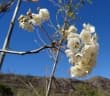
Dombeya rotundifolia
Dombeya rotundifolia
Safety & Hazards
None known
Cultivation Details
Mature plants can tolerate at least some frost[1, 2]. Grows best in a sunny position[2]. Established plants are drought tolerant[2]. In cultivation, species in this genus generally grow best in a moist but well-drained, fertile soil and a position in full sun or partial shade[3]. A fast-growing tree, it can grow 1 - 1.5 metres in a year[1, 2]. Mature trees have a dark brown, very rough and corky bark that forms a protective, fire resistant layer around the trunk[1].
Propagation
Seed - sow in deep seed trays in a semi-shaded position, The seed usually germinates within 3 weeks[1, 2]. Prick out the seedlings into individual containers once the first true leaves have formed and grow on in light shade[1]. Cuttings of semi-ripe wood, preferably with some bottom heat to encourage rooting[4]. Cite as: Tropical Plants Database, Ken Fern. tropical.theferns.info. 2026-02-20. <tropical.theferns.info/viewtropical.php?id=Dombeya+rotundifolia>
Pollinators
Bees
References
- [1]PlantZAfrica.com — http://www.plantzafrica.com ↩︎An excellent site giving detailed descriptions and uses of many S. African plants.
- [2]Protabase - Plant Resources of Tropical Africa. — http://www.prota.org ↩︎An excellent on-line database with detailed information on over 3,200 species of useful plants of Africa.
- [3]Encyclopedia of Tropical Plants - Identification and Cultivation of over 3,000 Tropical Plants — Ahmed Fayaz · Firefly Books Ltd.; New Zealand · 2011 · ISBN 978-1-55407-489 ↩︎A good photograph and terse but detailed information for over 3,000 species of tropical plants. An excellent reference.
- [4]The New RHS Dictionary of Gardening. 1992. — Huxley. A. · MacMillan Press · 1992 · ISBN 0-333-47494-5 ↩︎Excellent and very comprehensive, though it contains a number of silly mistakes. Readable yet also very detailed.
- [5]Flora Zambesiaca — http://apps.kew.org/efloras/fz/intro.html ↩︎An excellent online flora of plants from the Zambezi River basin. It lists a number of the plant uses as well as the habitats and botanical descriptions of the plants.
- [6]Useful Plants of Nyasaland — Williamson J. · The Government Printer, Zomba, Nyasaland. · 1955 · http://www.biodiversitylibrary.org ↩︎Brief details of the uses of almost 500 species of plants.
- [7]IUCN Red List of Threatened Species — http://www.iucnredlist.org/ ↩︎A list of plants under threat and facing possible extinction, usually with brief details of the threats and information on habitat.
- [8]Cornucopia II — Facciola. S. · Kampong Publications, California. · 1998 · ISBN 0-9628087-2-5 ↩︎The second edition of an excellent guide to the edible uses of plants, though it does not give any details of cultivation etc.
- [9]Swaziland's Flora - siSwati Names and Uses — Chris Long · 2005 · http://www.sntc.org.sz/flora/chrislong.asp ↩︎A basic, but very long, list of names and uses.
- [PFAF]Plants for a Future — pfaf.org ↩︎