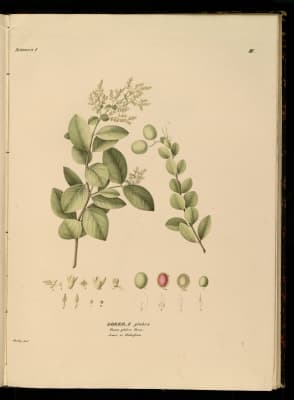
Dobera glabra
Dobera glabra
Safety & Hazards
None known
Cultivation Details
Succeeds in semi-arid tropical and subtropical areas, where it grows at elevations from sea level to 1,500 metres[1]. It grows best in areas where annual daytime temperatures are within the range 20 - 35 °c, but can tolerate 15 - 45 °c[2]. It prefers a mean annual rainfall ranging from 200 - 600mm, but tolerates 100 - 800mm[2]. Requires a sunny position[2]. Succeeds on sandy, alluvial, black cotton or calcareous loam soils[1]. Tolerates moderate levels of salt in the soil[2]. Prefers a pH in the range 6 - 8, tolerating 5.5 - 8.5[2]. Trees are able to withstand short-term waterlogging[1].
Propagation
Seeds should be collected from the trees just as the fruits are turning brown[1]. No pre-treatment is required before sowing, but germination is quite slow, probably dependent on the age of the seeds[1]. After extraction, seeds should be sown immediately[1]. Under ideal conditions, fresh and carefully extracted seeds germinate within 40 - 60 days, the expected germination rate for mature and healthy seed lots is 80% on average[1]. Growth is slow; even after a year, seedlings may have grown only 10 cm in height[1]. It is recommended that seedlings spend no more than 4 - 5 months in the nursery, as repeated root pruning will damage the plant[1]. An alternative is direct seeding, where seeds are planted just before the rains in some form of microcatchment[1]. The slow-growing, palatable seedlings need to be protected from browsing for the 1st 4 - 5 years of their lives[1]. The seed has a very short viability and needs to be sown within a few days of being separated from the fruit[1]. Cite as: Tropical Plants Database, Ken Fern. tropical.theferns.info. 2026-02-20. <tropical.theferns.info/viewtropical.php?id=Dobera+glabra>
Pollinators
Data unavailable
References
- [1]World Agroforesty Centre — http://www.worldagroforestry.org/ ↩︎An excellent online database of a huge range of trees giving very good information on each plant - its uses, ecology, identity, propagation, pests etc.
- [2]Ecocrop — http://ecocrop.fao.org/ecocrop/srv/en/home ↩︎Basic information on a wide range of useful plants, plus details of environmental needs where available.
- [3]Dictionary of Economic Plants. — Uphof. J. C. Th. · Weinheim · 1959 · ISBN - ↩︎An excellent and very comprehensive guide but it only gives very short descriptions of the uses without any details of how to utilize the plants. Not for the casual reader.