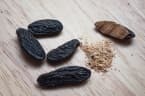
Dipteryx odorata
Dipteryx odorata
Safety & Hazards
The seeds contain 1 - 3% coumarins. When ingested, these can cause damage to the heart and liver and cause cancer[1]. The plant contains coumarin, a substance produced by the plant because it acts as an appetite suppressant and gives some protection from grazing – it is also the compound that gives some dried plants the smell of new mown hay. Coumarin is found naturally in many fruits, including strawberries, black currants, apricots, and cherries; it also has some medicinal applications, though it is also known to be toxic, affecting especially the liver and kidneys. Coumarin is of relatively low toxicity to humans – indeed it has often been used as a flavouring and aromatic additive in foods and other commodities. However, it can be much more toxic to other species, especially rodents and specifically rats. The fresh plant material, consumed in moderation, is generally safe. However, the dried plant material, especially if it is not dried properly and is invaded by fungi, is potentially much more toxic as the coumarin breaks down to form other compounds that can have a strongly anticoagulant effect upon the blood. Warfarin, a well-known anticoagulant drug and rat poison, is one of those compounds produced from coumarin.
Cultivation Details
Dipteryx odorata is a plant of the moister tropics, preferring a temperature that does not usually fall below about 15°c[1]. It grows best in areas where annual daytime temperatures are within the range 22 - 30°c, but can tolerate 16 - 34°c[2]. It prefers a mean annual rainfall of 2,000 - 2,500mm, but tolerates 1,300 - 4,000mm[2]. Succeeds in full sun or light shade[2]. Succeeds in a wide range of soils as long as they are well-drained, though it prefers a well-drained gravelly or sandy acid soil with ample rainfall and humidity[1, 3]. Prefers a pH in the range 5.5 - 6.5, tolerating 5 - 8.5[2]. Established plants can tolerate a certain amount of drought[3]. Seedling trees take about 5 years before they begin producing fruits[4]. Trees can commence production when just two years old if carefully cultivated, taking 7 - 10 years without cultivation[2]. The yield of dried beans per tree is normally 0.5 - 1 kilo annually, but there are reports that up to 25 kilos can be obtained[5]. Trees tend to only produce good crops every 2 - 3 years[5]. Local varieties had been developed in Brazil and Venezuela[4]. This species has a symbiotic relationship with certain soil bacteria, these bacteria form nodules on the roots and fix atmospheric nitrogen. Some of this nitrogen is utilized by the growing plant but some can also be used by other plants growing nearby[6].
Propagation
Seed - it has a very short viability and needs to be sown as soon as it is ripe[1]. Best sown in situ or in individual containers, since seedlings do not transplant well, fresh seed germinates in about 6 weeks[1]. Cite as: Tropical Plants Database, Ken Fern. tropical.theferns.info. 2026-02-20. <tropical.theferns.info/viewtropical.php?id=Dipteryx+odorata>
Pollinators
Insects
References
- [1]Encyclopaedia of Herbs and their Uses. — Bown. D. · Dorling Kindersley, London. · 1995 · ISBN 0-7513-020-31 ↩︎A very well presented and informative book on herbs from around the globe. Plenty in it for both the casual reader and the serious student. Just one main quibble is the silly way of having two separate entries for each plant.
- [2]Ecocrop — http://ecocrop.fao.org/ecocrop/srv/en/home ↩︎Basic information on a wide range of useful plants, plus details of environmental needs where available.
- [3]Present and Potential Commercial Timbers of the Caribbean — Longwood.F.R. · USDA Forest Service; Washington, DC. · 1962 ↩︎Quite detailed information on more than 60 species of Caribbean timber trees, giving species descriptions, habitat, detailed info on the wood and some info on other uses. Available for download on the internet.
- [4]Perennial Edible Fruits of the Tropics : an Inventory — Martin, F. W.; Campbell, C. W.; Rubertbe, R. M. · U.S. Dept. of Agriculture, Agricultural Research Service · 1987 ↩︎A booklet giving terse details of almost 300 species of edible fruits, plus regional lists of Botanical and Common names for over 2,500 less well-known edible fruits of the tropics.
- [5]Plant Resources of Southeast Asia — http://proseanet.org/ ↩︎Lots of information on the uses of the plants of SE Asia.
- [6]The New RHS Dictionary of Gardening. 1992. — Huxley. A. · MacMillan Press · 1992 · ISBN 0-333-47494-5 ↩︎Excellent and very comprehensive, though it contains a number of silly mistakes. Readable yet also very detailed.
- [7]Cornucopia II — Facciola. S. · Kampong Publications, California. · 1998 · ISBN 0-9628087-2-5 ↩︎The second edition of an excellent guide to the edible uses of plants, though it does not give any details of cultivation etc.
- [8]Mansfeld's Database of Agricultural and Horticultural Plants — http://mansfeld.ipk-gatersleben.de/pls/htmldb_pgrc/f?p=185:3:4292127278597336 ↩︎Terse details of a huge range of useful plants.
- [9]Dictionary of Economic Plants. — Uphof. J. C. Th. · Weinheim · 1959 · ISBN - ↩︎An excellent and very comprehensive guide but it only gives very short descriptions of the uses without any details of how to utilize the plants. Not for the casual reader.
- [10]Food Plants in the Americas: A Survey of the Domesticated, Cultivated, and Wild Plants Used for Human Food in North, — Kermath B.M.; Bennett B.C.' Pulsipher L.M. · 2014 ↩︎A pre-publication draft of an amazing, on-going work first started in 1985. It contains information on more than 3,900 taxa from the Americas - from Arctic regions to the Tropics
- [11]Flora of Peru — Macbride. J.F. · Field Museum of Natural History · 1936 ↩︎An excellent attempt at a Flora of Peru, though it is clear that many of the plants were imperfectly known at that time and so information on them was sketchy. Available for download from the Internet.
- [12]Medicinal Plants of the Guianas — DeFilipps, R. A.; Maina, S. L.; & Crepin, J. · Smithsonian Museum · http://botany.si.edu/bdg/medicinal/index.html ↩︎A down-loadable PDF document of a book in pre-publication awaiting illustration. An excellent, if rather terse, guide to the traditional medicinal uses of the plants of the region
- [13]Medicinal Plants of Brazil — Mors W.B.; Rizzini C.T.; Pereira N.A. · Reference Publications; Michigan. · 2000 · ISBN 0-917256-42-5 ↩︎An extremely concise book, listing approximately 1,500 species and varieties of plants with their botanical name, common name in Brazil, regions in Brazil where the plant is found, a brief list of uses and any medically active compounds in the plant.
- [14]Non-timber forest products of the North-West District of Guyana — van Andel T.R. · Tropenbos-Guyana Programme; Georgetown, Guyana · 2000 · ISBN 90-393-2536-7 ↩︎A very detailed study of the peoples and the plants they use, it includes a field guide to almost 500 species of useful plants.
- [15]Botanical Beads — Smith R.J. · http://www.botanicalbeads.com/ ↩︎A website looking at seeds that are used for ornament. It is based on a book that the author had written.