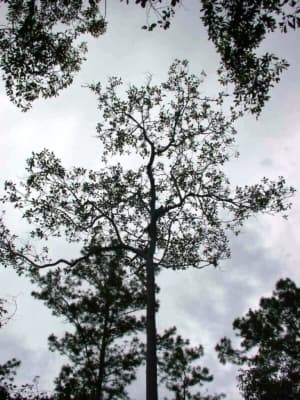
Dipterocarpus obtusifolius
Dipterocarpus obtusifolius
Safety & Hazards
None known
Cultivation Details
A tree of lowland to submontane regions in the tropics, where it can be fount at elevations of up to 1,300 metres. It grows best in a monsoon climate with a dry season of 3 - 6 months[1]. Seedlings require shade but the tree becomes light demanding as it matures[1].Grows best in a sandy or grey slightly acidic soil, which can be sometimes inundated in the rainy season[1]. Established plants are very drought tolerant[1]. Members of this genus generally only regenerate naturally in the shade of the forest. Seedlings and saplings can persist in dense forest shade for many years. In their first 2 years the young plants cannot tolerate major openings in the canopy, but after they are well established (about 120cm tall) the canopy can be opened up around them to speed up their growth[1]. Trees can be coppiced[2]. Trees have a thick, corky, deeply fissured bark that helps protect them from forest fires[2]. They are very resistant to forest fires[1].
Propagation
Seed - Cite as: Tropical Plants Database, Ken Fern. tropical.theferns.info. 2026-02-20. <tropical.theferns.info/viewtropical.php?id=Dipterocarpus+obtusifolius>
Pollinators
Data unavailable
References
- [1]Digital Compendium of Forestry Species of Cambodia — www.digitalspecies.blogspot.com; Phnom Penh · 2008 · http://www.digitalspecies.blogspot.com ↩︎A very detailed booklet, produced in PDF format on the internet, giving information on around 100 species of trees.
- [2]Flora Malesiana Series 1 — Various · Nationaal Herbarium Nederiand, Universiteit Leiden branch · http://www.archive.org ↩︎A massive treatment of the plants of the Malaysian Archipelago. Much of it has been made available to download from the Internet
- [3]IUCN Red List of Threatened Species — http://www.iucnredlist.org/ ↩︎A list of plants under threat and facing possible extinction, usually with brief details of the threats and information on habitat.
- [4]Biotik, Laos — http://biotik.org/species_list_laos.html ↩︎Information on more than 100 species of Laotian trees.
- [5]Vegetable Gums and Resins. — Howes. F. N. · Faber · ISBN 81-88818-17-8 ↩︎A very good book dealing with the subject in a readable way.
- [6]A Manual of Indian Timbers. — Gamble. J. S. · Bishen Singh Mahendra Pal Singh · 1972 · ISBN - ↩︎First written in the 19th century, but still a classic, giving a lot of information on the uses and habitats of Indian trees. Not for the casual reader.